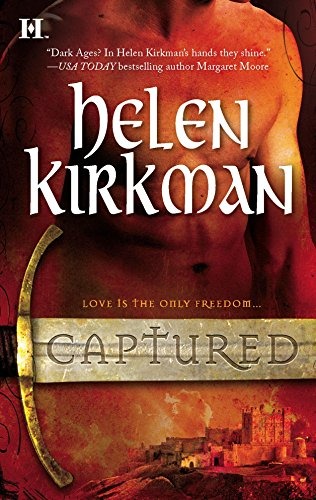
“Captured” by Helen Kirkman [Femdom Book Review]

One of the hardest parts of this project remains that books with femdom in them are poorly labeled, giving you little warning about what you are getting into. It’s only recently that romance.io even made a distinction between “fem-dom” (do not ask me why they think it needed a hyphen) and general “BDSM” as a tag, and otherwise we are stuck with recommendations and trying to judge books by their proverbial covers. When is a “take charge” heroine code for one who merely shows a modicum of competence, and when is it signaling and will grab the hero by the literal balls? 

At the same time, it usually takes me a couple of days of focused attention to read a novel length book, and at a weekly review schedule that means that it’s perfectly possible to pick a book that *might* be potentially worth it and come away bleakly disappointed. Which, for pleasure reading is just part of the experience, but for my (self imposed) deadline eats into time I could spend on something I know definitely at least meets criteria of having femdom. That inversely is at odds with my other hope with this project, to expand the pool of searchable works beyond the same handful of titles getting recommended over and over. But if I find a dud and other people thought it was femdom I am at least doing a public service by calling attention to a false flag. 

Inversely, I am not sure how much people want to read 600 to 1000 words of “Pearl had a hunch based on the ghost of a hint and was wrong”. And you really can’t tell. You would think a work like Her Bridegroom Bought And Paid For would have delivered, but that one was rather Alphahole male dom. This is a game of roulette with both my time and exposure to squick. 

Captured, therefore, was a big risk only made possible by slotting reading it into what was supposed to be fun time not review time. Having found Daughter of the Blood an unpleasant read, and stumbling on a thread of books that inverted the trope of a Princess being given to a Barbarian to a Barbarian being given to a Princess, I gave it a careful look over in case anything popped out. Most of the titles suggested were the usual he men alpha shocks priss who then surrenders to his aura of erotic menace, but on the list was Forbidden by Helen Kirkman, promising to be a princess and slave. The male lead was in chains on the cover.  So I tried to find a copy. 

Only Kirkman is a now obscure, trad published (Harlequin) historical author who seemed to stop writing in the late aughts. The best even behemoths like Amazon can do is help you buy you a second-hand paperback from a third party. You cannot buy her work as an e-book, at least through any search engine I tried.  And yet, I gave it a shot in my library catalogue and found not my goal but another captive male romance by her later in the series Captured. It was free, so why not? I could always just DNF and it was Sunday night so I had time to grab a more reliable replacement if I had to. 

I say all this to let you know how low my expectations were going in. Reader, I inhaled the damn thing that night, staying up until midnight to finish it. I liked it. I liked the dynamic, the setting, the plot, even the purple prose sex scenes where everything is a bit discombobulated and dream-like. 

As for what you get: It’s England in the 700s, a period when everything was a fractured bunch of smaller tribal groups and you could find three absolute kings in what is now day trip driving distance. This may be a tough setting to jump into for people whose preference for historicals leans more to the restrained and familiar Regency period, but for someone whose parents met through the SCA, the deep cuts of the cultural roots of the UK are my happy place. 

Princess Rosamund is living in a Viking camp after being handed to them by her Mercian Royal relatives as a bargaining tool. Things have not gone well. The Viking are plundering their way through Wessex, and just brutally murdered a bunch of hostages so that they can keep doing that. Rosamund, knowing this will not end well one way or another, is looking to get the hell out of here with the money she has squirreled away being the favoured mistress of one of the ranking members of the group. And then she stumbles upon Boda, a battered, chained and unconscious captive in the hands of the guy who personally carried out the killing of the hostages. Rosamund takes one look at his helpless body (and red hair) and is smitten. She assertively wins the guy in a game of dice and hauls him back to her tent. 

She then waits until he is conscious to have her way with him, in a dramatic and immediate escalation. I had been extremely worried that the books genre and time period would mean things would go the way things usually do, where the captive male lead (restrained or not) terrorizes the heroine with his erotic assertions. But, while there’s a brief point where he tries to assert himself, it isn’t via sexual assault to put her in her place or some such, and Rosamund takes control again by giving him a handjob she is very clearly enjoying, both the act itself and the knowledge she has the literal upper hand in her skill at seduction. 

The book also takes advantage of her understood profession as a camp follower to give her lots of dialogue about just wanting the captive as her bed warmer. We do not need her to be a virgin he opens to pleasures she has never known, or coy about this or her immense sexual confidence. While Rosamund’s not exactly happy about having been handed over to Vikings, she’s been thriving about as much anyone can, with remarkable savoire faire.

But all isn’t as it seems. Boda is an escaped slave-convict from the peasantry of Mercia, rough speaking and working as a mercenary for Wessex, but his capture is no mere chance. Meanwhile, cultured refined Rosamund is hiding a secret of her own. Nevertheless they both have their own reasons to be unwilling to return to Mercia and Boda agrees that when the time is right he will help her and her teenage maid Merriwen escape. 

Merriwen is one of the other things that adds charm to the book. With everyone’s perception she is “simple” you get what would be more accurate to a describe as an autistic person who has been accidentally infantilized due to people underestimating her capacity to function. Now 16, Merriwen will do some things that cause problems for our leads, but these make sense once you know who Merriwen really is and compare how she is being treated. Honourable mention also goes to the way two side characters, Olga, another camp follower, and Od, one of the minions of the book’s villain, are handled. Both could have been depicted as one dimensional, the bad sex worker to contrast with the virtuous heroine, and the superstitious mini-boss to be overcome. 

Of course you are probably mostly wondering about the femdom, and what I would say is that you have is a combo of plot conveniently giving some fetish fodder (whump, bondage) and structural explorations of fealty that dovetail nicely with maintaining Rosamund’s power even into book end.  This is another place to see handled well, particularly more than just “well you won’t have any more real world power any more, but let’s be kinky still” is usually as good as it gets.

Working in service to this conclusion is Boda’s massive childhood trauma. He has deeply internalized his lowly status, not just peasant but the tier below it, as a thrall  pushed into that status by his father’s crimes. Thus the other obstacle in the characters’ way, outside of the primary issue of marauding Vikings and medieval war crimes, is his ambivalence about accepting rewards for his exemplary military performance that would raise his rank. He has already turned them down once, and Rosamund, regardless of the real truth about her, is a noble. Despite her clear and straightforward interest in him and repeatedly pointing out absolutely 0 people would successfully prosecute a war hero in a completely different kingdom for being an escaped slave, he’s all set to throw away their HEA based on not being good enough for her. 

The resolution of that is deeply satisfying and narratively consistent to that concept of fealty. After receiving lands and status as a reward for various heroics, he passes them all to her. He will marry her, yes, but she has to be the head of their household. While it also turns out she was correct and the risks of his dark past putting him in trouble is him wildly blowing things out of proportion, their respective roles with each other remain in a way they both find works for them. Even no longer a slave, they are able to turn the dynamics of fealty and of knight and lady into a very satisfyingly implied FLR.

—-

Where to buy: 

Look for copies on places like thriftbooks.com or check your local library because this one is a hard to find gem. 

Liked this review? Check out more titles in my 2026 Femdom Book Review Project!

“At His Countess’ Pleasure” by Olivia Waite [Femdom Book Review]

At His Countess' Pleasure by Olivia Waite. The cover depicts a woman in a red dress with clasped hands. She is standing against a blue background.

After a scandal between the families puts Anne Pym and her sisters in a socially precarious position, Simon Rushford, Earl of Underwood aims to resolve this reputational damage by making her his Countess. A whole bunch of light, entirely consensual femdom ensues while Anne adjusts to this marriage and comes into her own, with the rest of the plot conflict being driven by Anne attempting to live up to her own expectations as much as those of others, and Simon being a bit dumb. 

This is one of those 3.5 star situations, where its good parts were somewhat smothered by its problems. That’s not to say I hated the book, even if I was exasperated with it (and the characters) at times. Its main flaw is that it’s under done, but in the sense that it desperately needed more book to fill out what it was trying to do. Waite can write, with a particular knack for sex scenes, but the flow of individual pieces is very choppy. However, as far as erotica and hand under the covers reading, it executes what it is trying to do sincerely and with enough story and commitment to physical realism to underline it’s trying to take its own material seriously.

Other than that, though, the conflict here is probably the book’s weakest part. There’s plenty of problems for the heroine to solve, such as finding her feet in society, managing various scandals, and reconciling herself to things she can’t have, but we take until the last third of the book before there’s any real challenge. Capital R Romance (as a genre) has a beat structure and theme that isn’t being hewed to very hard here. Particularly germaine to abandoning forumula, the hero is a kind of gormless easy going individual who seems to exist to be agreeable and reassuring, but also cause most of the fuck ups. He is certainly very earnest, but also very stupid in a way that’s never particularly explored, essentially leaving the other half of the potential plot conflict entirely unaddressed. 

Particularly notable is that he is an utter dumb-dumb about sex, to the extent that a first major point of drama in the relationship is that he is flabbergasted to discover that a change in costume is enough to render his wife attractive. Nevertheless, his Madonna/Whore complex causes no further dysfunction in their love life and does nothing to change his opinion of her when he discovers she likes fucking him. This is a bit of a head scratcher that he is very bought into the idea of duty, proprietary and the fragility of women of his social class, but has none of the drawbacks this is usually packaged with in real life. 

Instead, Simon is written like someone who would be startled to discover carriages that aren’t painted red can still go fast. Inversely, Anne’s makeover from debutante pastels to bright colours (this being all it takes for Simon to realize she is hot) is in no way an effort to dress for his benefit, a purely happy accident. She likes fucking her husband, once he shows an interest in her, but her love for him never shifts from an increasingly appreciative check list. Additional tinkering could have taken this from Anne reacting to things and concluding it could be much worse, to her own example being a more traditional catalyst of change in her partner as well. 

Still, the main conceit the book is built on is pretty refreshing. Anne is a plausible sexually dominant, including approaching the inevitable historical romance virginity loss scene with full enthusiasm instead of a rather cliche reticence. Inversely, I enjoyed her hesitancy in figuring out her new social milieu and reconciling the real fact that dominants are not magic fountains of universal confidence. The plot, had it held together a little better, had its interesting points and avoided a lot of the more irksome versions of the tropes it explored. 

But I would have liked to see Simon ever have to confront the fact that he caused not only most of the problems in this book, but is largely insulated by his privilege in a way others are not. We are supposed to treat his marriage to Anne as some sort of mutual sacrifice, but in reality, he gives her a very difficult job entirely for his benefit. At no point does his terrible decision making process ever cause him real consequences, largely because Anne keeps dealing with it for him. No lessons are learned, Simon shall be Simon until he dies. 

This earnest range of fuck ups even starts with the prior book in this series, where we are told he plays an accidental part in the leaking of someone’s nude painting. The scandal from that is what puts Anne in a position where marriage to her is a sort of rescue, but even so she also represents a convenient solution to his feeling of obligation to marry someone out of duty. Then, once their sex life is off and humming we discover actually he knocked up his last mistress, but once again Anne is dealing with the worst of it entirely to his advantage. I am not even asking for a comeuppance. It’s just that Simon is never significantly impacted by any of this, and always less than Anne.

Indeed Simon does not get so much as a side eye from being surprised all the unprotected sex he had with other women he wasn’t married to resulted in pregnancy and then this secret being mismanaged by him. He talks about not being as slutty as his brother, and this, by his measure, seems to have been enough in his mind and nobody confronts him about this because the book keeps very modern sensibilities. No sex, no matter how irresponsible, is to be shamed. So, instead, he is briefly flustered by the mess, then Anne solves his problem, he then wanders off to play with the new baby. 

The strongest conflict, found in the last third of the book, doesn’t really concern Simon at all, just Anne putting up with a lot for her cousin (heroine from the last book) and confronting finding out something about herself that will impact their life together, rattling her confidence in the process.  This, about three months into their marriage (timelines are a bit rushed, it might have been max a year), puts a bit of a damper on their sex life while she deals with her feelings about that. It’s here you see where this would be a better book if Waite had given it more time. We could have built into this better about what sudden sexual dysfunction means to Anne. Instead, problem established we lurch into a happy ending by way of a pegging scene and then a time skip. 

Honestly, the pegging prose itself was well done, and so rare to find that I can forgive a lot. Nevertheless, it’s that ongoing choppiness of flow here that makes this scene nice but bewildering, rather than fantastic. What could have been an additional escalation becomes simply a dildo out of left field. 

To emphasize on how bizarre this is, nothing to this point suggests anything more sexually adventurous on Simon’s part than oral sex. A bit of editing could have handled this better, dropping the more complicated kink sooner into his perspective or maybe exploring that as part of the Madonna/Whore thing we started with. Instead we are left head scratching. How does Simon know about butt stuff, a historically realtively supressed sex act even compared to oral? We never get much insight, but for plot convenience he has a porn image to share with his wife as a way of guide and the firm belief this is just what Anne needs. Is this a secret vulnerable fantasy he dwelled on, revealed only as an act of trust? Did he do this loads with those prior partners? No, it’s pretty much just Simon doing Simon things.

By his logic, if Anne is feeling depressed enough she doesn’t want to do PiV, clearly what Simon thinks will cheer her up is putting a dildo in his butt. Tahdah, no more pressure on her to be wet enough to penetrate! Luckily, as pretty much every other hare brained idea of Simon’s so far, it goes great. 

About the only thing I can say to Simon’s credit is that he always does the wrong thing, but says the right thing afterwards. He offers Anne no help figuring out posh society, but cheerfully reminds her she is doing great while watching her struggle from the sidelines. He drops a surprise baby in her lap, fluffs about in a panic until Anne rescues him and then turns into instant perfect modern dad so the audience can coo over baby time. When Anne is sad because of a thing she has learned that impacts their sex life he says something supportive about centering her feelings not his. And then he offers her his butthole in this trying time. 

This is probably something of a pattern with how the book treats solving problems. When Simon played a part in harming Anne and her family, his solution to marry her is treated rather like a unilaterally good thing, rather than either excessive to what had been actually asked of him (and a gift with considerable strings). When the impregnated former mistress shows up on the doorstep, Anne in turn adds her to the household with a job, purely so Simon can get more time with the baby, and we are supposed to assume that this is a lovely, gracious thing to do to the other woman and not, again, a hard job that asks her to continue to subordinate herself to both main characters for a problem largely caused by Simon. The pegging at the end is almost a rule of thirds conclusion of this pattern. The problem of being unable to feel as aroused because of a very real point of stress is treated like Anne’s problem that Simon tenderly solves. In reality, it’s Simon saying “here is a sex act we can do when you aren’t as horny that will still benefit me”.

Simon adds to Anne’s life by adding massive social prestige and wealth, but in his own self characterization, this is more like the desirable cart attached to a particularly clumsy ox. The rest of Anne’s life is not particularly a net positive by his presence in it, and at times he feels his positives are more like a sexy lamp that could be replaced by a wise mentor stock character. One can even read a darker interpretation of his marriage to Anne that he knows he’s actually offering a less than good deal and figured her desperation would make up for it. 

These, incidentally, are all interesting conflicts that could have been addressed if we had about 25% more book. I credit Waite here that she’s clearly got the insight and writing ability to have ironed out these problems and made Simon either less of a bliss-ninny or have him reign in more of his worst tendencies in regards to this flaw as part of character development. I also don’t think the circumstances this was published in gave Waite the support to do so, thus one can’t complain too much.

This forms, by the way, the crux of my review dilemma. To nurture more femdom books into existence, existing works must be more widely read and shared. Nevertheless, this must be done with compassion and the knowledge that writers in this niche are operating at a severe disadvantage, most typically in the indie space.

As an indie, “At His Countess’ Pleasure” must be judged, not by the standards of the bigger budget books, but what is accomplished with less. One thus forgives much: typos, lower grade graphics on the covers, things that didn’t always land as precisely as we might hope, and so on. Often they are the byproduct of a single creator wearing many hats, and these errors really can be treated as irrelevant to the overall whole.  As an example of the genre of Romance, and assuming the creator had all the tools of a big budget book, this needed to go back to the metaphorical kitchen. As an example of something put together cottage industry style with no support to speak of and profit margins that border on an entirely labour of love level, Waite pulled this off phenomenally, bringing her talent and technical skill to a part of the book market that can trend into shovel ware. 

Thus my conclusion: it wasn’t a waste of time to read this and if Waite does any other femdom I’d happily give that a shot too. As an Erotic Romance, it’s a bit weak in how it assembles the R part, but if you are into firm but gentle F/m, the E is solid and could stand on its own if that was all you wanted.


Where To Buy: At His Countess’ Pleasure by Olivia Waite

Femdom Review: Bold Seduction

Or: “The Bold Seduction Of Professor Hornsby”

It’s Regency Femdom Week, but I am immensely busy trying to dodge a pandemic to safely meet my submissive, and don’t have the undivided attention to bang out a proper work of fiction. Instead I offer a Regency Historical Romance review by way of consolation!

“Bold Seduction” is available on Amazon here as an exclusively digital book, as well as the standard kobo, nook, etc… At the time of writing this review it’s still on sale for 99 cents, but the regular price is quite fair too. I receive no affiliate or financial benefits from my review, and the closest I am to the author is following her on Twitter.

The book, itself

The Bold Seduction (of Professor Hornsyby) by Karyn Gerrard, was something I grabbed on sale for 99 cents. The premise was unusual- a male virgin, so I was intrigued to see what she would do with it, although I had never read anything by her before.

I am very glad I did.

I keep saying the problem isn’t that femdom content isn’t out there, it’s that it is seldom flagged as femdom. This particular novel manages to hit enough points to do better than many things that call themselves thus, and with the organization of the first annual Regency Femdom Week,  I would be remiss not to both review and promote this book.

Our hero, Philomena, or “Phil”, is a brothel madam who still occasionally sees clients. She’s now in her early 30s and doing very comfortably, but getting a little bit bored. Thus when she is hired by the well meaning friends of Spencer, the third son of a nobleman, to relieve him of his virginity, she takes the job herself. “Professor” Spencer is autistic, and as an austistic person (me), his portrayal is probably my favourite in fiction so far.

The book is from a short story, and now is the launch of a trilogy. I can see why she gave it a second pass and more fleshing out; it was well worth its increased length. Although it’s very much an erotic romance, there is no gratuitous sex, and an extremely slow burn story, as much about cooking and getting to know one another than bedroom romps. I usually skip the sex scenes in romances, and I never felt I needed to here.

This is not hard femdom, but (author) knows how to build a tease and denial atmosphere, replete with edging. Despite her mission, and the hero’s reluctance, our protagonist manages to reaffirm enthusiastic consent every step of the way. The convenient remote location and lack of transportation to and from the hero’s isolated house gives the characters space to get to know each other and her to respect the initial no without immediately leaving. If not strictly a Christmas romance, with the framing of New Years in the background, this is a Holiday story that holds up year round.

Content note to femdom hungry readers:

Although most of the sex is very directed and initiated by her, as Spencer starts to feel his oats, the heroine enjoys him taking a more assertive role occasionally.

It does not, however, disempower her or flip roles completely. He very innocently keeps joking about her being a queen in a way that I find is often a real life tell for a sub guy in the wild.

As a person who has done the sexual initiation thing, I generally find I appreciate knowing I have installed confidence into my target. I generally don’t code it as “dominant” in my emotional experience of his behaviour, but I enjoy Silver takes initiative and doesn’t confine himself to by the numbers submission.

This book does zero sadomasochism and manages to affirm enthusiastic content with natural regularity. There is no bondage, and no degradation. You won’t enjoy this if you are hunting harder kinks, but I found it nicely hit on the right notes for a naturally occurring FLR.

What about its success as a genre piece & romance?

There’s all the good stuff of a historical romance: Dresses. Navigating social class. Self discovery. Social ruin. The fantasy of inequality put in the service of feeling powerful. We don’t, thankfully, get a surprise extra level of enobling, but the hero is the third son of an Earl, so this isn’t strictly speaking the rare historical commoner romance.

Phil’s approach to sex work doesn’t go down quite so obnoxiously as many heroines, although this does do the “only client I actually ever was attracted to”. She is a victim of an abduction into her trade, which I was a little cautious of, and a little foreshadowing that her wicked aunt and uncle may have intentionally disposed of her into this state of social ruin. Luckily this book doesn’t assert all sex workers are victims, but touches on her colleagues having a huge scope of different experiences and relationships with what they do for a living.

Buried in all this, however, is a very lovely story about the isolation of trauma. Maybe this is particular to me, my autism exists in a space of unclear beginning/end between serious business abuse I survived. Spencer and Phil are both living in self imposed silos of isolation because of abuse, and that’s rather the connection point I can understand how they get each other.

Emotionally Avoidant People In Love

Phil and Spencer are using intense self reliance as a means to be safe, and neither is very trusting. Spencer overtly is never sure if he can trust the good intentions of anyone but his family due to very real past experiences. Phil, meanwhile, repeatedly remarks she respects, but isn’t close to her colleagues in her business, with a very obvious theme of nurturing but arms length to them. For example, a character mentioned repeatedly, but not introduced “Darius” her business’s security, is a rescue from a back alley beating, and I can bet that her “nobody cares about me” attitude never uttered self pityingly, is ruthlessly enforced. 

Spencer makes her feel safe because she is so busy unpuzzling him and accommodating, that the inevitable love sneaks up and grabs her unawares. She makes him feel safe because she narrates everything she is doing with him and takes the time to explain something he’s hitherto been exposed to as something humans are supposed to automatically figure out.

Another thing I found pleasant in Gerrard’s depiction of autism was that she skipped the trope of inherent misanthropy. The hero is withdrawn, not because he can’t connect with people, but because the experience of being autistic has provided repeated trauma, both sensory processing and socially. We learn his inevitable social class fueled boarding school experience was an exercise in learning to suppress to survive. But we also see a family that, like every family tree with autism in it, has learned to accommodate.

What Spencer has, that Phil doesn’t, is a foundation of being loved by family, that he is able to share, in turn, by loving her.

And (hooray!), he is no Rain Man. True, he is an academic, but he’s not framed as a magic savant, just a guy with a strong knack for his field of study. I also had to grin when I saw him doggedly (and implied accurately) using the medium of classical history to understand human behaviour- oops, hello me! He also isn’t a particularly successful scholar as far as achievement- his “Professor” is a courtesy title he’s chasing because he seems to be trying to leverage his talents to overcome his disability.

Spencer also wanders around being boggled Phil doesn’t send him into a meltdown, again, see me with a big Cheshire cat grin. With spectrum disorders you can come to believe your worst is normal. In reality, the severity goes up and down with how stressed you are, so a discovery of a modicum of empathy and acceptance can seem miraculous.

Although I don’t consider saying their is a HEA is a spoiler, I am going to park a more tag before I touch on the climax of the novel.

Read more

Femdom Book Review: At His Lady’s Command by Nicola Davidson

This is a cream puff. It’s a sugary, gooey confection you bite into and there is flakey bits all over your blouse and custard oozing out, but you aren’t sorry you did it. Our protagonists, Lady Portia and her faithful bodyguard Denham start out as unrequited, and within a chapter, rush from lust to bed at speed- we aren’t making any pretence this isn’t porn.

With that in mind, if you are looking for exact historical accuracy, this might not be for you. Rich heiress runs a sexual dream society attended by pairings and a triad from other books, and does good works. The past-ish background serves largely as a fig leaf to add propriety to rebel against and peril to intrude. As such, the premises of the plot can fall apart if you stare too long at them.

This is gentle femdom. Don’t expect bondage or sadomaschism more intense than scratches, but do enjoy that our 38 year old heroine and 44 year old hero are plausibly into each other and her control, while also keeping them as firmly defined equals outside the context of their kinks.

Honestly my biggest criticism is the speed the story was rushed interfered with the possability of larger tension and made the peril of the story a bit less fleshed in favour of Denham or Portia yearning for each other. But!

Holy hell is it a breath of fresh air to get a protagonist that is not a professional. Not that being a pro is bad, but the vast majority of femdom romances targeted for the female gaze approach the subject as a story of an idealized dominatrix, usually a service top. The characters like eachother and compliment eachother. They have plausible chemistry.

Davidson looks like she knows what she is talking about, when it comes to femdom, and although her larger suite of offerings covers pretty much the gamut of relationships (looks like M/f, a mmf triad, lesbian and gay make up the other books in her Surrey Sexual Freedom Society series, for example) this is not a tick box sampler or someone writing outside their depth.

This may be pure romance-land in the larger framing, but expect a good fusion of modern tastes and historical vulgarity- nobody does a cockstand or has a mossy grot, but there are no throbbing members. I would have a hard time placing the exactness of period, but they do manage birth control that is both plausible and historically accurate.

In all, I wish Davidson had the time to let this develop properly with more length, but having tasted her wears, even if I might have a stray crumb or two to brush away, I will be back to this particular bakery again.

Want a copy? At His Lady’s Command is a kindle exclusive. I bought it myself on a whim and have received no sponsorship to review.