“The Snow Queen” by Elizabeth Gannon [Femdom Book Review]

Oh no, it’s dreadful. There’s no redeeming moment or characters here, and it slides into him dominating her by the middle of the book, after a captivity segment that was tedious and free of any sort of enjoyable tension. And it’s not like the writer doesn’t know it, we even finish with an author’s note this is early career and they don’t think it’s very good.

The original Snow Queen is a lovely fable about a girl (Gerda)  on an adventure to rescue her childhood friend, one that feels ancient without being actually all that old, dreamy, sharp and with a brutal edge lurking in the background. Gannon’s Snow Queen trying for an endearing villainess romance retelling, but mostly manages to replicate the experience of a creepy fantasy wanker in your inbox asking you to help him try out femdom and calls you Mommy without your consent. Before sliding into the even more annoying idea that dominant women want to be called good girl all along. 

To accomplish this, the character of Kai goes from an urban dweller twisted by a shard of a beauty distorted mirror in his eye, to an immensely ham-fisted depiction of a neurodivergent person in a small village. He is still selfish, but rather than a remote coldness, now he impotently gets into trouble by making everyone’s lives harder, while we are supposed to think he is sympathetic were it not for being awkward. Gerda is now his sister, head shakingly tired of his antics, as is everyone else in the village. 

Otherwise the theme is uwu cutsie, and peppered with modern references in an otherwise fairytale pastoral. The Snow Queen is significantly defanged to merely making threats, even an assassination attempt just being brushed off with a bit of thumping. She’s no longer an icy, fae like personification of winter, but the new sorcerer-monarch whose reign has been marked by complete disinterest in ruling due to her sulking. She started when she was 16, has ruled for 30 years and is written as if she got stuck at the age she started.

This is what powerful women need, to be proven as not as scary and humanized. Clearly. 

Meanwhile, within day 2 of his captivity Kai is making pancakes and getting in trouble for starting fires without permission, has agreed with the Snow Queen that people in his village should be murdered, and is otherwise doing the usual gothic beauty and the beast retelling shit of offending the grump while befriending her talking animal minion. To justify his durance in the Snow Queen’s custody, this version’s Kai has to reassemble a shattered artifact the villagers broke. Which he is good at, but still bad at everything else. How bad he is at everything is being milked for comedy, and the more that teat is squeezed the more aware you get this is about as productive as milking a bull. Which is to say eventually painful. 

The intent is that we are supposed to see her won over by his good heart. The reality is that actually the evil village Council member “Derriks” almost immediately becomes the most sympathetic character. He has tried to rebel against the Snow Queen with violence, but the narrative lets us know diplomacy has failed and the Snow Queen’s neglect is killing the village. His dialogue is cartoonish but deeply unfunny, yet ten minutes with the other characters you can see why he got voted in. Through his eyes we learn the hero, Kai,  spends most of his time drunk, or wasting your time with poorly done presentations about how he is going to totally find artifacts that will return the village into a tourism hotspot.  

I think we are supposed to take it, as a modern audience, that archeology is a worthwhile pursuit. Kai imagines if he can just uncover the early history of the village a place we have established is shit to do shipping through will suddenly host all sorts of visitors who want to see ancient but mundane relics. The book does a pretty good job of convincing us this isn’t the case, regardless of what the author intended. Kai not only bores and annoys the villagers, he bores and annoys me. When bad guy Derriks fantasizes about throwing him into the harbour, rather than emphasizing the character’s villainy, the main feeling I get is sympathy. 

Even more damningly, the narrative gives us no explanation of how Kai got so good at archeology, which is incredibly lazy writing. You can do a neurodivergent awkward professor type character well, with the right grounding, but the text spends more time introducing Kai’s head of resentment that he isn’t special than it does anything else about him. He is an entitled ass with nothing to justify it. Not even to us. It would have taken absolutely not effort to sketch out any sort of self taught back story or demonstration of a technique better than digging up the local town square at random (yes, really) but the book prefers to spend its effort on interminable whining from Kai about how he isn’t even short or ugly, just average.

His attitude and treatment of the titular Snow Queen isn’t much better. It’s ironic that evil Derriks is depicted that way via having him leer over Kai’s sister, because that’s exactly what Kai does the moment he meets our female lead. Brooding mostly silent heroines of great potential violence are, themselves, not bad tropes, but we really lose something here by not getting her perspective until a quarter of the way into the book. When we do it’s even more disappointing. Apparently despite lots of emphasis there’s nothing remarkable about Kai, the Snow Queen immediately thought he was hot.

Unfortunately, while there’s a half hearted attempt at the trope of melting your dominant’s frozen heart, the cozy/comedy aspect of the story constantly undermines things with Kai’s cringe banter. It’s not funny, it’s a jerk finally reaching a point someone can stop him continuing to not take things seriously. Confrontations with the Snow Queen are tedious and frivolous, for example he is as concerned with disliking the soup as much as not getting to work on the project properly. This was written in 2013, there’s not even the start of a “it was a different time” argument here.

Of course in addition to displaying 0 respect for the female lead, he instantly puts his mind to determining if she is single, and because of the plot she also finds him inexplicably adorable. All while her wolf minion irreverently makes little comments to remove any remaining mystique. While there’s probably a clear overlap here with Disney’s Frozen for the book’s publication (also 2013) for the choice of the subject, it’s an achievement to manage a botched retelling where Kai is even more made the center of the universe than the nonsense Disney inflicted.

I think as far as failing its tension, in addition to just plain bad writing, this is a problem role reversal occasionally finds itself in where sexism plus fretting about the right kind of consent lead to a complete and repulsive defanging. The captivity plot is pure gender flip, but since the rest of the world is leering male counselors and Kai consistently treats her with the same disrespect he approaches everyone else, the impact is closer to a very specific male fantasy. 

That one is that a sparkling perfect magical woman will see him, the saddest of sad sack schlubs, as a diamond in the rough. Her dominant aura will do all the work to make him feel horny/submissive and she will transform him while falling hopelessly in love. As a submissive fantasy, sure, but I have yet to meet a dominant who sees gross incompetence as hot. Since the target audience here is women, this is even more baffling.

And then we get this line, after he discovers her real name. Said un-ironically. 

You should smile more.” He said finally.  “It… it suits you.”

This is pretty much Kai through and through. Not why she doesn’t smile, but then she, like everything else in the universe, exists for him, the main character. Basically she’s that joke by Kate Beaton. 

http://www.harkavagrant.com/index.php?id=311

But weird gender dynamics aside, the other reason the book sucks is that it doesn’t respect its own narrative in favour of creating more opportunity for (failing at) clowning. During the pancakes scene we are told Kai, who is a cook at his family tavern, can actually make edible food. Despite this, the book wants to have a funny kitchen disaster some time later, and settles on him not knowing the difference between oil and vinegar when he fails at making lunch. This is despite being previously told he could cook reasonably well in a proper kitchen. The author just wanted to have a getting to know you kitchen scene where he gets to be a quirky screwball.

And of course the person he is supposed playing off doesn’t fit the role she’s been assigned either. She is treated like she’s the rules follower to his chaos, but the rest of the book has already established the Snow Queen is shirking responsibility and not particularly rules bound herself. The sub-genre might have dynamics like it was trying for enough people might expect it, but the book is lazy and poorly edited enough to ram this level of randomness into the text without backing it up.

The least said about the deeply unfunny random heroes who attack the better. Joke wasn’t good, characters added nothing. Tonally this feels like runtime padding. However, having fucked around enough to reach the middle of the book and to establish the characters are on speaking terms we abruptly switch to them having terrible sex where he rips her clothes off (destroying them) and tells her that he doesn’t have to listen to her and he is too good at sex for her to correct him. Kai, king of the losers, with no information for the audience about his past experience, is a sexual savant.

Then the artifact is fixed, the village rejoices and he then dominates her while she’s tied up with chains of ice. It’s not a good sex scene either. This is about as erotic as calling the tax office to make a correction.

That that’s just 60% in. The rest is more time wasting wank, unfunny banter, and no stakes confrontations with councilman Derriks. A happy ending is achieved, Kai gets everything he wants. The Snow Queen is slavishly devoted to him and he gets to enjoy a badass is at his beck and call and being special. The last part of this book was read with a fixed disgusted expression, all charity gone. If this wasn’t for review I would habe DNF’d ages ago.

Yuck. Who is this for? About the only thing this book serves to do is encourage you that if you worry you aren’t good enough for publishing to do it anyway. If this shit got 4.4 stars out of 167 reviews, your personal pet project can’t possibly be worse.


Where To Buy:

Author’s Sites:
Liked this review? Check out more titles in my 2026 Femdom Book Review Project!

“What Fury Brings” by Tricia Levenseller [Femdom Book Review]

What Fury Brings by Tricia Levenseller

In a Greco-Roman fantasy world, various gods award their client populations gifts. For the country of Amarra, that’s to be stronger than any (cis) man, a fact that has led to a warlike society of Amazons with a distinct man shortage in their upper caste, causing them to have a practice of forced marriage harvested from their neighbors. Meanwhile everywhere else is a sea of ultra machismo masculinity.  In reaction, the Amarrans are also hard, harsh and violent, including our protagonist, Olerra, one of the leading candidates for the (elected) throne of her country. She’s hoping that she can leverage her status as general to impress her electorate (a small council of noble women), and in service to that she decides that nothing but the hand of a neighboring prince will do. 

Amarra’s’ most immediate rival a people who worship the god Brutus and therefore are known even internally as Brutes.  It is known that Brutes get higher than average fecundity thanks to their deity, but turn around and use that to create a culture of very fragile patriarchy, where the most powerful treat their wives and daughters as non-entities, but live in terror of their sons. For me I was a lot more curious about the fertility gift. We established that the Amarran strength wasn’t limitless as the King of the Brutes could still fight off multiple warriors, is the fertility a gender based blessing? What are the limits here? The King has multiple children but nothing unusual for someone having a lot of sex sans birth control over several decades. We hear about his five sons, of which the male protagonist is the eldest, and a daughter, while a reasonably determined person can get into the double digits if they keep at it most of their adult reproductive life. My grandfather, for example, is the youngest of 10.

When we learn Olerra’s darkest secret, that she lacks the strength awarded to all cis women of her society, I had suspected the actual truth would be that nobody in the society had real magic and it was social constructs the whole way down. You can still take that reading here as correct, but that’s not where this story goes. 

Instead it’s warrior/warrior, abduction and forced proximity plus fake romance, with a liberal pile of femdom to glue it all together. Olerra conspires to abduct a husband from the heart of her enemy’s kingdom and grabs the wrong brother, Sano, the crown prince. Sanos decides, for strategic reasons, not to correct this misunderstanding up front and then they slowly come to fall in love as Olerra does her level best to “housebreak” her captive into the more demure model of Amarran masculinity and he comes to appreciate her pure hearted sincerity. 

The way to read this is to turn your brain off and enjoy the ride. Up front, any nitpicking of the world building comes at the expense of the dubcon femdom. Likewise, a book which gives you an on page reason to refer to men as Brutes is not trying to be subtle and realistic. And in doing relax and enjoy approach, it also needs to be said that there’s nothing here that, gender flipped, would be remarkable in a romance about a male warrior-noble abducting a bride. Romance heroines have been slowly chipping away at their hot blooded ambitious warrior captors until they mutually surrender to the bonds of true love since forever. And they have done so on looser premises than this. 

It is true that somewhere in the back of What Fury Brings you can see the DNA of Wonder Woman, in the idea that a society under loving female authority would be largely utopia, but unfortunately somehow men get in their own way of accepting that. But this is also a sort of gender flip Gor, for despite being liberated for 500 years, the glue that holds Amarran society is the humiliation and subjection of men. Amarrans are inordinately obsessed with that, particularly the nobles, with lots of stories about how terribly rapey men are amidst a brutal culture of female on male rape. Again, take this as a feature not a bug. 

Probably because of that aforementioned clause that deity gifts are still beatable by exceptional individuals, Amarra really leans into restrictions on their men well past even the strictures of even an actual historical roman slave.  Even fighting back to the point of drawing blood from a woman is a death sentence and the murder of one noble woman, Olerra’s mother, lead to a purge of all adult noble men. 

Timelines get a bit hazy here, as the husband kidnapping is described as a tradition, but the massive gendercide that’s made it more popular happened within Olerra’s lifetime. The absolute trauma of everyone else’s father, adult son, brother or grandfather being murdered is not something that ever comes up, even though every adult noble woman you would interact with in the story would have lost multiple loved ones to a purge that made even some of the more out of hand European witch burnings seem restrained. You really have to just accept this is a convenient man shortage. 

Still, what is difficult to put your finger on is just how much this is a matter of unreliable narrators, how much is plot convenience and how much is a society that really, really hates cis men to the point of undermining its own modern feminist inclinations. What point do you need to be, after all, to overreact so wildly you are murdering everyone from 85 to 18 under suspicion of conspiracy to rebel? And what does this end up saying to the idea that “if women were in charge things would be different” when they are objectively worse? 

The book gives the on-page explanation this is what fury brings, but 500 years is a long time to stay mad, a timeline under which, for example, the real world went from medieval to space exploration (or if you want to stay Greco-Roman, the Athenian heyday to the advent of Christianity in the Roman empire). This has nothing to do with fury and everything to do with an intersection of fantasy clichés of excessively long timelines. The geography is pretty handwavey too, with the capital of Amarra and Brutus a short carriage ride from each other, yet different enough in climates to justify one character needing sun protection. Again, the parts of Northern Italy and Southern Italy where you can get that much genetic and climate drift are still considerably further apart. But will we let errors in cartography get in the way of pornography?

I only flag the nitpicks in the end, not because I think the book is bad for its flaws, but because the audience for femdom romance is excruciatingly selective. Forewarned means that you can go into this without a common response I find in our reader circles of getting your hopes up and then feeling particularly betrayed. I obviously can’t flag everything you the reader might personally find irksome, but I do these reviews to help people get an idea of what might be worth taking a risk on. 

And, ultimately everything is just here as a premise to justify the kidnapping of the male lead and make him more special. This isn’t a story about a woman trying to reform her society because her brother’s life was made forfeit by a deeply violent society, it’s one where the heroine being middling bad (for no reason other than random chance) in a society of terribly bad is a ray of reforming hope. 

Of course, lest you worry this is a TERF paradise, the opening glossary makes sure we are aware the Amarrans have a queer positive culture, with trans, non-binary and same gender couples galore. This is unlike the Brutes, who expect this to keep on the downlow.  Unfortunately though, it’s the sort of trans positive culture where any gender non-conformity to the binary firmly lands you in third gender status. The goddess gift of strength doesn’t work on trans women, yes, but they don’t get it, and it also does not work on trans men. I am going to give the writer the benefit of the doubt and say there’s no reason to assume their deity is perfect rather than that it’s an endorsement modern trans people are less valid.

The other part that’s very much a symptom of the modern era is what’s *not* included in the trigger warnings. We hit the ground running in a battle to take down the King of the Brutes, whereby the solution to his behaviour was to live capture, tie him to a chair, gloat a bit and then release him to his people stark naked to humiliate him. The King then goes home and strips his adult sons stark naked to flog them. Four chapters in and the fetish counter is making constant dinging noises, but none of this is being interpreted as vaguely sexual for purposes of warning the audience. 

This is really a problem about fetish stuff versus social norms about content notes. Because much of what is kinky is not inherently sexual, it means that it exists in a context of plausible deniability. But neither is the dubcob being flagged. The book depends heavily on body betrayal syndrome, and the male lead being aroused by something to make it clear surprises are ok. Things like tying the lead up and fingering his ass, without him realizing that was a possibility, are ok if he expected to have some sort of non-PiV sex. The trigger warnings demurely say the sexual assaults are off page, but every facet of this story is relentlessly horny.

Which is probably the books most winning feature. Every single part of it is twisted itself into the sole purpose of offering you more attempts at femdom for women and theorizing about a masculine friendly version of F/m. Want not men doing naked oil wrestling for your amusement? It’s got that. Sex markets where you can get a skilled man into what really gets you off? It’s got that too. Lovingly lavish descriptions of male fashions to simultaneously emphasize masculinity and make the man into a delectable and beautiful object of desire? It wants you to have that. 

But for me, my biggest personal nitpick (outside the recent voluntary gendercide being handwaved as more inconvenient than traumatic) is probably the part where Sanos comes to internalize Ammaran social superiority. There’s a reasonable conversation about the limits of trying to protect your kin from sexism versus social reform, but the point he is won over is that common men in the street seem happy in their subjugated position. There’s some contrast here in that while Amarran nobles are absurdly decadent in their harems, whereas there’s implication that commoners don’t have time for thirty men to exist in entirely decorative subjugation, but enough context clues to know that men are so constrained in this society they aren’t really out without female escort and they aren’t handling money. 

This is generally held up to being what Sanos and Olerra both see as ok. They don’t want all the grooming and domestic violence in either direction, but they are nobles and their concept of the world is not one where hierarchies are flattened, only softened. 

But there are moments where that background assumption gets a bit messy, never more so than the self congratulatory attitude around the penis guillotine scene. It’s presence is framed as being used to punish the worst of the worst, a man who raped a child. The idea is that it tells you that Amarra is harsh but fair, at worst a little preoccupied with certain risks over others. 

In actual impression it comes across that there’s such an appetite for seeing bad things happen to men that Amarra, lacking enough villains in their own borders, imports criminals from other countries so people can come and watch an evil man get his comeuppance. And our female protagonist gives our male protagonist a little lecture about how it helps with the inherent make tendency to rape…despite our introduction to her culture involving a paralytic toxin that leaves you with an erection used on consorts who misbehave, the villain openly being known to being likely to force an underage member of her harem to consummate and another character being considered unremarkable that she has a harem of entirely children. The book lets us know she is actually running a clandestine orphanage not a grooming operation, but apparently Amarra is so anti man that keeping a couple of dozen boys as consorts in training is less weird than openly running a school for under privileged boys. 

Meanwhile a lot of dialogue between the characters repeatedly confronts Sanos with his hypocrisy. Olerra is supposed to be the one who thinks bigger than him, but from an audience perspective, we are able to see her blind spots but he can’t. Inversely Sanos is not so far behind her as Olerra acts. She calls out his tendency to use chivalry in place of systemic repair, but he has something that’s much harder to discard in misogynistic cultures, the belief in fundamental inherent gender equality. Sanos somehow manages to avoid all the usual baggage that women are dumber, more cowardly, manipulative, etc.. that goes with real world sexism. 

So the guillotine becomes one of those moments where I can’t tell if this was supposed to be porn or praxis, but mostly it was a moment of the book trying to have their cake and eat it too. I base this on the fact that Amarra also uses voluntary eunuchs as high prestige servants  for unclear reasons. These men, it is made clear, are not being punished, but if you want a job in a noble household as a man it’s a mandatory requirement. Why? No reason given, so I think Levenseller just likes castration as a fetish. But the narrative also wants to have some moral line and it does ask you to give them more but in that I can here. 

Finally, in trying to bridge that problem of making members of a monstrous society sympathetic, the tactic deployed is that we are shown much worse people. The king of the Brutes abuses his sons, and Olerra’s rival to the throne is (most disgusting of disgusting vices)… a sadist!!!    

Sadism here is depicted as impossible to exist in a context of consent. It has to be the violent mishandling of unconsenting men, and is contrasted with the mainline Amarrans way of controlling their men, keeping them physically restrained and sexual tease and denial. It’s a sort of tyranny of gentle femdom, which as a story is supposed to let you relax your moral calibration to sample your edge fetishes as bad things and have your main ones as acceptable. As a premise it is understandable, but it also puts you in an awkward position that your happily ever after creates a line where half the stuff you enjoyed as a reader is going to arbitrarily be put in the shameful category. 

Thus penis guillotines are for good women to get off to bad men being chopped. Abusing your sex slaves is for good women to be titillated by but to ultimately condemn.  Other things are made arbitrarily ok, but ultimately when good triumphs in this story most of the stricter and more cruel fetish parts are to be swept up off the stage like discarded lingerie after a burlesque show. 

And I think the part of the ending that might make at least some potential audience give it a hard pass is in the HEA. After Olerra has fought many times over and won due to a combination of sheer skill, cunning and purity of heart, and after Sanos has learned to trust her and let her lead; they are cozy together as a couple discussing the future. And Olerra mentions they might switch sometimes. As character development it’s her learning to trust men and be vulnerable, as a Domme it was the disappointing inevitability of how tied to the situation a lot of the kink was. Olerra wasn’t constantly restraining Sanos because it was her fetish, she was frightened of him having the upper hand. When she loses that fear, she loses her justification to tie him up. 

For most people that’s going to be enough, but I know some of you would find a hint of switching would make you feel entirely undermined, so I think I need to mention that. 

But, caveats aside, I actually liked it. I liked the sex scenes. I liked the slow mutual understanding. I liked Sanos being an object of display and the almost fourth wall breaking internal observation he made about how shocking it was he got to be beautiful. I even liked the premise that the most popular brothel in Brutus as a make-believe version of Amarra because while the narrative through Dani’s perspective implied it was just to humble powerful women, I think it also pointed to how miserable men in ultra patriarchy are that they can’t help yearning for something else. It also delivered something a lot of femdom books struggle with, two leads I liked and thought suited each other. It even evaded one of my least favourite femdom tropes that submissive men in particular have to be inherently feminized to occupy that role. 

And, ultimately, even if the leads end with the shy possibility of switching on the table, it’s also notable that in a book which is incredibly open about sex, did not see fit to write that.  Sure, it’s there to let us know femdom doesn’t have to be compulsory, but you never get the vibe you as the audience were being told you had to endure some male dom as turn about. 

Which, review-wise, it’s good. It hits everything most people who want more femdom romances are looking for. While some books are a chore to get through, I knocked this one off in two binge read sessions, entirely entertained the whole time.


Where to buy: 

Author website: Tricia Levenseller

Liked this review? Check out more titles in my 2026 Femdom Book Review Project!

“Enchanting the Fae Queen” by Stephanie Burgis [Femdom Book Review]

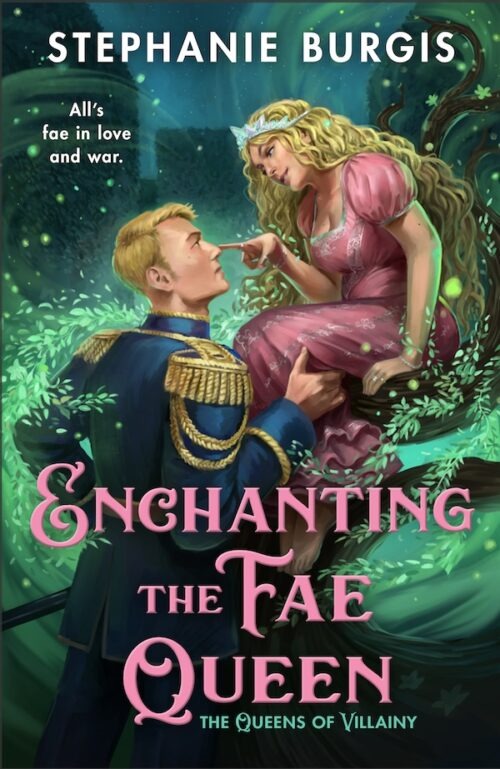
Enchanting the Fae Queen by Stephanie Burgis cover. It shows a blonde woman in a princess dress booping the nose of a blond man in a blue military uniform. The tagline is "All's fae in love and war"

When you are trying to find femdom books, while some things tag themselves explicitly, a lot more of what is out there hides in plain sight. You have to either read everything and hope to be surprised or try to make educated guesses from the subtext inherent in a book’s premises or the cover art. This review is a follow up after an unexpected find, the next book in a series “The Queens of Villainy”, and I preordered it almost immediately finishing the preceding story, Wooing The Witch Queen. 

Well, I’ve read it. Let the author enjoy her well deserved status on the USA Today best seller list for this book, but Enchanting the Fae Queen is not following up on the overt femdom themes of the last one. There’s a switch/primal thing being attempted here instead, which is many people will like, but not my cup of tea. 

It’s a fluffy cupcake, full of banter and glitter and rapid fire fae perils. Other reviewers are showering it with stars and I absolutely won’t stand in their way. I hope Burgis continues to climb to a well deserved state of ongoing success.

Besides switching still shouldn’t entirely invalidate someone’s dominance just because they don’t do it all the time. And Burgis hardly promised this was going to be femdom, too. She only promised a captive male lead who is an uptight golden boy over-achiever virgin and you could argue I just got my hopes up too much. So, with that in mind, here is my own opinion of what is wrong here, outside of just the fact that I don’t like male dominance. 

Most notably, I don’t think Burgis trusted her audience enough to make Lorelei have any unlikeable traits linked to anything the character excelled at. I feel like she had to make the character’s malice so ineffectual because she was worried the captivity plot would erode the potential space for consent, but accidentally replicated one of my major pet peeves with how sexism impacts the genre of romance. Female characters aren’t actually allowed to be competently bad or otherwise effectively mean, because writers fear audiences will think they are unredeemable more so than the same behaviour from a man. 

I won’t say writers are obligated to pretend that isn’t a real bias when they consider creating a marketable work, but it does become immediately obvious whenever a female character is supposed to be dominant even part of the time. And it sucks. 

Of course people are forever kidnapping each other in romances. Readers like a good forced proximity and peril story and it injects a frisson of darkness many people find titillating. However, because of the gendered way we assume characters are allowed to behave, when a male character kidnaps a female character he gets way more grace to be threatening. Of course his motives may vary. Sometimes he is a ruthless pirate. Or doing it for her own good to hide her from her real enemies. Or consumed with BDSM flavoured lust. Regardless, the captivity is always treated as a real peril and his capacity to do so is based on a recognized ability to handle himself and exert an actual ongoing threat. 

When female characters kidnap male characters it’s almost always an immediate farce, full of whimsical misunderstandings and feminine embarrassment. Her motives always have to be noble, or at least coerced by outside forces and almost immediately things dissolve into a sort of baby voiced “gee mister I didn’t mean you any harm, honest I didn’t even know how guns worked when I shot you, aw shucks, don’t be maaaaaad”. Then the captive dude grudgingly comes to accept she doesn’t have a malicious bone in her body, she just got carried away, etc… but he is also at no point going to be more than surprised to find himself detained. Furthermore, once he realizes she is responsible, he will adopt a stern faced “little girl this prank has gone too far” attitude. She will blush and fume and stamp her little feetsies before ultimately coming to conclude the hero knows best. 

As a dominant top who is here to get thrilled by the hero actually being bested and helpless, I am very used to being recommended toothless kidnapping farces, of which this is yet another unremarkable example. What I want is gender flipped Beauty and the Beasts, what I get is stories where men being abducted can’t really do more than be irritated because a woman did it. Burgis is writing in the YA space so there wasn’t going to be much real darkness to begin with, but if this book was trying for a powerful take-charge heroine it undermined her too much to make that feel remotely plausible. 

Thus the intermittent bondage inflicted on the male lead is not quite enough to get over the way the heroine’s behaviour and reactions undermine things.  Even when she has the upper hand she immediately starts whimpering that she doesn’t feel powerful because he is hot. I would say this was trying to make sure it strangled all elements of power exchange all together, but notably the hero is allowed to take her in his strong grip and fantasize about her reaction to being helpless to him without being overwhelmed by her beauty. When they are in opposition he simply isn’t scared, just inconvenienced, whereas she is constantly terrified by the idea he might get her off.

This extends to the characters’ behavior and reactions outside of the romantic parts. We are supposed to take her seriously, but Lorelei is just too childish for me to buy the “appearances can be deceiving” premise she’s been given as far as her frivolity being an act. She’s not playing it up, she really is an impulsive hot mess who shouldn’t be put in charge of a lemonade stand, much less be a head of state. 

Although the story starts off with a show of her dramatic magics and her pulling off a surprise abduction of a VIP, it quickly loses that steam. Almost immediately the plot lands them in a death trap she needs the hero’s help to escape, but they are there entirely due to her own prior, somewhat baffling choices. Thus, the peril feels that if happens because she incompetent and over confident, rather than an unforeseeable curveball. Indeed, as if to drive this home, the narrative has her mention how she’s a victim of constant assassination attempts and treachery from Fae and mortal alike, but she’s genuinely caught flat footed that someone maneuvers against her while she drags a prisoner through a somewhat dubious team building scheme. 

The queens part of the “Queens of Villainy” framing device is also getting pretty strained here too. Saskia, protagonist of Wooing The Witch Queen, does queen related activities that show that the day to day of her nation is deferred to a Prime Minister, but she’s still serving her nation by shoring up the magical defences. And there’s discussion of how her hereditary legitimacy is holding together a much more consensus bases compromise system. Meanwhile, Lorelei’s role as monarch of Balravia has moved her into whatever the Political Science version of sexy lamp territory. 

We are told the throne was bitterly fought for, and that she had to take it to protect the Fae minority within its borders, but we don’t even get the skeleton of a plan for how she is achieving this. Is she veto-ing laws? Sending troops to suppress Fae hunters? Organizing faerie affirmative action programs to ensure diverse representation in the civil service? We will never know this. She is the queen in the very conservative Romantasy sense of right of birth followed by right by violence. Her dad made a deal with the Fae and Lorelei has imported Fae handmaids, so presumably Balravia has to listen to her. But this book could have easily made her just a powerful citizen of the country and nothing else would change about the story, particularly because she can just vanish for days at a time and her citizens don’t seem effected. 

(Side note, as far as her only other act of leadership we see her barging into the party of a neighboring empire and terrorizing the other guests. We are told they deserve this for expelling their Fae population, but this is never framed as an if/then threat, just a show of power the guests react to with reasonable fear for their lives. This is very a Saturday morning cartoon level simplification, depending on a premise that these hoity toity Empire bigots won’t immediately read this as an act of war. C’mon Lorelei, Baron Midtier Moderate over there just pissed himself because he thought he was about to be ended by greenery. You think this is advancing equality? Your whole pitch is that you are telling them you are just having fun, so the magical equivalent of firing a gun into the air isn’t even tied to a stated grievance deeper than not being invited to a party. She’s supposed to be a champion of the downtrodden but her goal appears to be to make people think Fae are capricious lunatics.)

Otherwise, Lorelei does absolutely zero actual leading, whining even her closest advisors (who are also all fae for some reason) push her around. She has a seat at the table in an alliance, but has already fucked up with them in the last book. About the only relevance her monarch status really provides here is her petulant insistence that faeries in the Fae only realm use her title as Queen, not her title in their world as Princess. But, ultimately she’s still all Tiara and no Tax Policy. 

Burgis has made the male lead, Gerard an ascetic virgin, and Lorelei’s an openly lusty hedonist, but any actual sexual interactions and she’s not doing anything remarkable with that experience while he already magically knows what to do with no real direction. This isn’t pulling off inverted expectations either, the narrative just doesn’t trust the heroine enough to actually have made any part of her supposed past sexual escapades rewarding.

And I think that’s the part I found most peeving. In a genre currently ruled by fanfic style tags as marketing, this book did promise certain things via its tropes and then failed to properly explore them. 

I think Burgis was trying for her female lead being misrepresented as an overstated succubus due to slut shaming. Instead it kind of comes across as anti-sexual exploration. Lorelei has been hurt repeatedly by all past lovers while Gerard saved himself for reasons, as it turned out, included simple disinterest in anyone else as much as it being the right choice pragmatically. Because all her past lovers were false and murderous, Lorelei is supposed to be traumatized and closed off, whereas Gerard saved himself for his true love… and has zero sexual hang ups. 

And Gerard (and what we should assume is based on his lifetime of experience with his trusty hand?) is written as veritable sex god. There’s ways to subvert the trope of blushing virginity, but from a first kiss that may very well be his first kiss ever he is doing the lip biting thing that really isn’t a rookie friendly maneuver. That’s just iffy writing. And nothing else is particularly plausible after that.

Wooing The Witch Queen was almost sexless, but this book’s couple does plenty of going at it on page. I am starting to wonder if the choice in the first book wasn’t to keep things YA friendly, but because either Burgis or their editor cannot imagine sex where the woman isn’t the one behaving like a cliché heroine who has never known such pleasure from a man (who incidentally knows her body better than she does). It’s very boilerplate sex.  The progressive kind of boilerplate, where we make sure the reader knows her orgasm is a priority, but very box ticking nevertheless. 

And another thing, since I think I am struggling to stay positive here and might as well get it off my chest… There’s only so many times Lorelei can break off their embrace with “no, I am actually too scared to do this because it feels good!” and then get gently put down again by the hero before you don’t want them to try again until they have an adult conversation. Likewise the narrative repeatedly reassuring us Gerard immediately stops goes from a hat tip to the importance of consent to worryingly repetitive that he needs to acknowledge in his own head he isn’t going to rape her.  

Even outside of sex, Enchanting the Fae Queen is too eager to show how similar the characters are to actually let Lorelei be better than Gerard at anything that matters, even things she should far exceed him at. He knows about as much magical lore as she does, navigates the Fae realm as equally competently as someone who is one, and handles the other Fae about as effectively as she does. In his one moment of real vulnerability to Fae more so than her is really more of a her problem that she has to surrender to. 

Meanwhile, Lorelei is not a good leader; not a particularly effective strategist; not particularly bright; not remarkably good at sex; and not really well respected even by technical peers. There’s a scene where the book compares her to a small animal desperately trying to protect babies, and maybe it was trying to get across that actually she had a heart of gold, but mostly it served to emphasize how her immaturity diminished her. She’s not a good person, she’s a smol bean who has been handed power by other people. This is a bad contrast against someone you built up as a self made genius. He overcame all odds and is stressed by the demands placed on him, but also self assured inside and out. She’s a scared, clingy baby telling us she’s only “pretending” to be extremely emotional. And lots is said about how it benefits her not to be taken seriously, but we never see that give her any advantage.

Now granted, there’s a scene at the end where the hero suddenly gets hit with the idiot stick and needs rescuing too. But, at that point Lorelei immediately turns to her other magical alliance besties to do most of the heavy lifting, concluding actually she needs to accept they are allowed to scold her like a junior member of the group if they are to help her. The story arc here is how the Queen of Fae learns to open herself up and accept other people will make good choices for her and how she very much never knows best by herself. 

There a turn of phrase I like for what happened here, the Impossible Burger Romance (credit @thedextriarchy.bsky.social) where a writer tries a non-traditional premise, but is so concerned the readers won’t be happy with that they immediately veer back into doing the most traditional story they can. As a result this isn’t even a switch romance. This is a Daddy and brat story where Daddy likes to be consensually topped from time to time, even if babygirl feels shy when she does it. The book desperately wants there to be a girl power element, without trusting the heroine to have any real power of her own. 

Sure, maybe that’s your thing, but it’s poison to writing even a part time power exchange dynamic and it’s not a stable enough foundation to pull off the nemesis part either. Lorelei’s not Gerard’s enemy, she’s, at best, a tsundere whose idea of plotting and international intrigue is a literal stink bomb. By book’s end she has his attention and Gerard’s bridges are duly burned with his own faction, what even are they going to banter about to play fight over? 

In aggregate it delivers a light afternoon read where two characters bicker their way through a series of challenges while slowly succumbing to their desire for each other. That’s enough to sell a book. But as well as not delivering what I hoped it might, it’s also not enough to sell what it advertised it was trying to do. I think this is a pity because Burgis has been better when they stay non traditional and would have been a better book if they did that here too. I will finish things up with the third book when it comes out, but it won’t be with any raised hopes. 


Where to buy: Enchanting the Fae Queen by Stephanie Burgis