
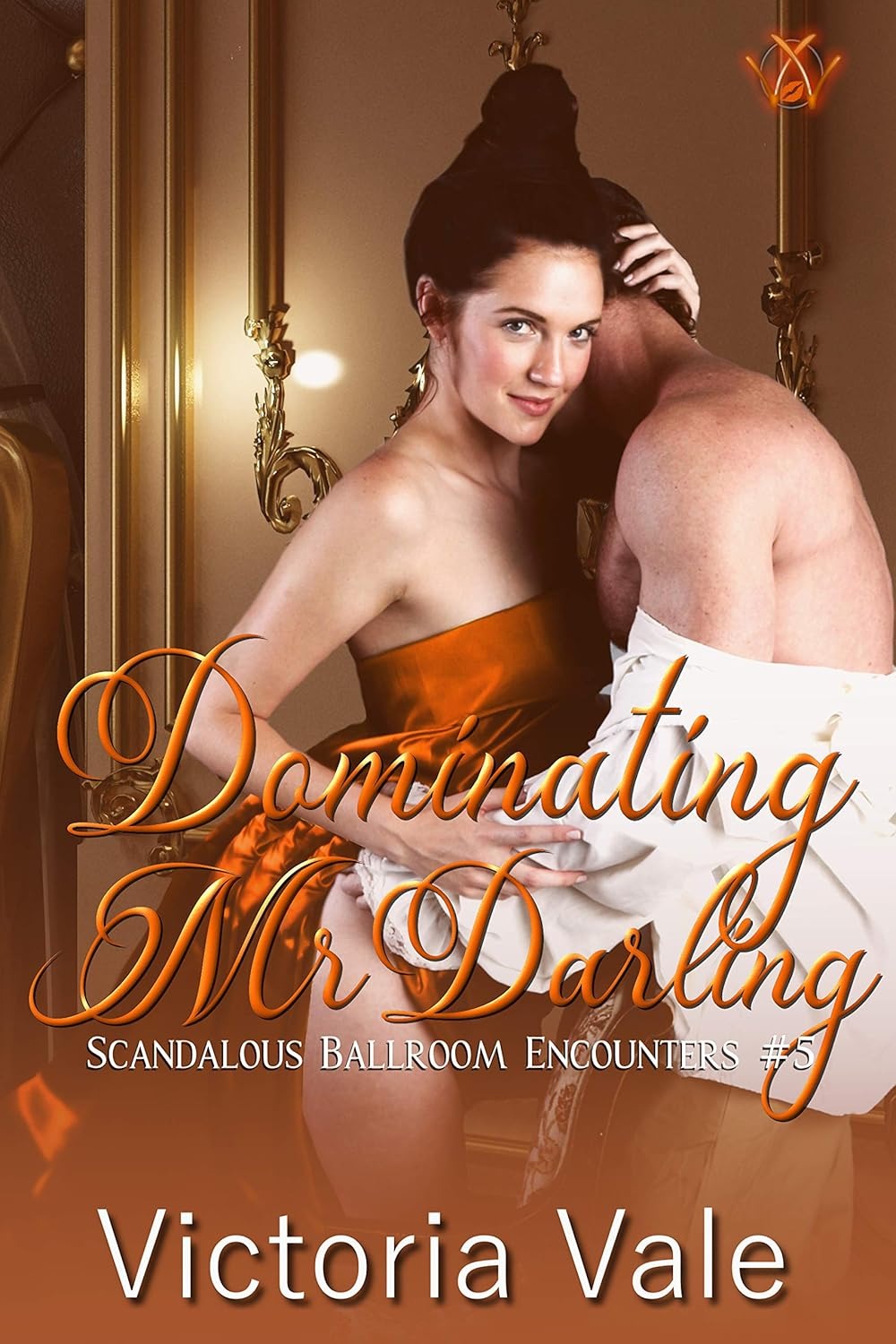
Well, they can’t all be winners, I guess? Although “The Damsel” by the same author is probably on my short list for favourite works out of everything I have reviewed so far, “Dominating Mr. Darling” by Victoria Vale definitely isn’t. Honestly, it’s pretty bad. A bait and (literal!) switch storyline; an actively annoying male lead; and a tendency to contradict its own premises mean I just didn’t like this one, and I don’t think most people will either.
As far as plot, here’s the jist: She’s the sister to the nobility, an heiress with an immense dowry. He is a mere mister with a bankrupt farming concern that desperately needs an infusion of capital. She’s an experienced dominant, but though he has never done anything like this before he quickly becomes immersed in her world. The book sells itself as a Domme (Lady Amelia Fitzwilliam) finally finding the perfect sub for her (the titular Mr. Darling), in an erotic historical romance setting. What you actually get is not that.
Instead, this is about a woman who normally identifies as a dominant learning to love and be vulnerable through her submission to the male lead. While it implies that after this she goes back to being dominant with him, the book doesn’t trust the premise enough to allow her self discovery to be possible through someone else’s submission. If you were buying this based on the implications of the title and blurb, you are going to be disappointed.
If you are the sort of person who is specifically seeking books with femdom in them, you are going to hate the book based on that problem alone. Perhaps unique of all groups, because of the normative pressures against women being dominant or men being submissive, we tend to be extra sensitive to anything that implies this is a phase, a facade or otherwise lacks a full emotional range.
Even so, sometimes even a serious flaw like that can just be an error in marketing. However, none of the other pieces of Dominating Mr. Darling come together well, either. Not the depictions of BDSM; not pulling off the stakes of the conflict; and not the figleaf of a historical setting. Each individually doesn’t work well, and in combination only serves to emphasize the flaws of the other parts.
Of course, romance has always had a fuzzy attitude towards historical accuracy, treating it as negotiable. For every Flowers from the Storm, you are going to get a dozen Bridgertons. That’s not a bad thing, sometimes the past is just an excuse for pretty ballgowns or certain kinds of drama, and we aren’t here for the other stuff. And BDSM romances often take liberties too, favouring interesting conflicts over being strict manuals of how to kink responsibly. This is a feature not a bug. There’s room for books about healthy BDSM as just how the couples connect, but not all fantasies need to be diegetic good representation.
But, where Dominating Mr. Darling pairs vaguely Regency tropes (balls, social season, titles, marrying for money by default) with contemporary assumptions about how BDSM works (safewords, leather corsets), both feel like they were sort of counting on the other part to compensate for any compromises made.
The historical setting gives us some costuming and a smattering of aesthetics. But, otherwise, for most of the book this really could have been about contemporary ultra rich people and nothing would have changed. Our heroine is an heiress who hangs out in men’s wear in casinos and fairly openly takes lovers inside and outside her own social class. At the same time, she is described as being the belle of good society, going so far as to be called “the Incomparable” by the consensus of the other aristocrats. Because we are in historical land she does have to contend with pressure to marry and the implication that doing so is a more or less one way journey, but there’s basement dungeons and modern style sex parties just about everywhere. Thus, because there’s no actual teeth to any of the other draw backs fo the setting, the result makes her seem like a rebel without a consequence.
Inversely, for all it pays lip service to modern concepts of consent, the lack of practical understanding of theory would probably be better suited to one where the characters could plead ignorance due to time period. Either you are telling a story where your husband has full legal rights over you and this is about how you navigate that as a person who wants to dom OR you are telling a story where those rules don’t apply. But then if you do that you lose a lot of leeway for the people to be trash at the BDSM part, which this book depends on to drive the conflict.
Which is to say even as a switch romance it still falls on its face. The hero is an idiot who repeatedly wildly over steps whenever he is in a dominant role. His first decision, when faced with an opportunity to take charge for an evening, is to try to use that for real world leverage (commanding her to marry him). His next jaunt at that is to force her to reveal her secret in the most traumatic way possible. The third time involves her stripping off her fetish gear style symbols of dominance for some sort of reconciliation, after he has demanded she not shut him out when he fucked up the prior time. At no point does anyone acknowledge just how ridiculous that is because the reader is supposed to see this behaviour as daring and romantic. He cares about her so much he will take big swings and big risks, forcing her to do what she secretly wants.
Sure, that’s a common part of submissive fantasies, but even if you are looking to do that you need to actually reasonably sell the idea that the dominant has the skill to do that. Or even that she needed to be rescued from her false front. Obviously I have my own reader bias about the trope that dominant seeming women just need the right man to take them down, but it doesn’t even do this well either.
Instead, the book hasn’t taken the time to set up a premise where she is making a distinction between a mistress persona and herself, or how much her wild child self presentation is actually a smoke screen. For example there’s absolutely no role conflict after he marries her and sets her to the high femme business of ornamenting his home. All her earlier casino crossdressing becomes irrelevant and she takes to her midbook rustication with nary a bit of tension. Inversely, despite the book wanting us to take him equally seriously as a dominant, it also doesn’t suggest any effort on his part to learn to do this safely or respectfully. Or even that he understands what he did has been consistently bugnuts. He is supposed to be brash, but mostly this just comes across as entitled.
The book takes a lot of time to establish she took years of supervised instruction to dominate well (not something I even enjoy, but hey, that’s the book’s argument about how this works, not me), but two scenes later, both extreme disasters, and the hero is treated as on par with her for his ability to take charge. Not only does this make for an obnoxious character, it becomes just another facet of how Mr. Darling’s monumental ego is treated as a good thing, and Lady Amelia’s confidence is something to be disrespected.
It also struggles with a problem many romance novels do, when the universe conspires to undermine one of the characters and make it clear everyone else has collectively concluded any resistance on their part to the other lead is silly. Faced with ambivalence or issues, everyone is quick to remind Lady Amelia this guy is clearly different to her and this would be good for her. Any misgiving she has is treated like she just needs to open up her heart a little, every conversation with other characters and the dialogue always slides to how good the hero will be for her if she only stops trying to trust her own judgment. One conversation between the men later and Lady Amelia’s primary source of social protection, her brother, is completely won over and her to tell her why she really needs to go along with this Mr. Darling person. Even when he openly tells her brother the object of his affection has said no after a verify ham handed proposal.
But we never see why Mr. Darling is different in a good way. Lady Amelia’s clearly found other subs to play with in the past. We get hints she’s struggled to find one eligible for class reasons, but we never actually learn why this guy is not like the other nobles and gentry. It seems to be trying to imply nobody else would ever bother to challenge her tsundere façade, but she is never given enough unreasonable prickles to pull that off.
Nor do we really confront the fortune hunter aspect on Mr. Darling’s part, and how she gets treated like the hot piece of ass attached to some tempting investment capital. It’s used in a sex scene and they sort of bring it up as a bickering topic, but the narrative and dialogue of the other characters agree this is to be treated as petty on her part to consider it. The best angle we go for is that he was obviously going to marry wealthy, but she is a special money source, unlike any other heiress. The benefit to Lady Amelia is supposed to be that she’s so traumatized by her past that only Mr. Darling can actually accept her and tear down her walls. But at no point is she unreasonably pushing people away. Actually she’s always written as being open to others and letting them please her. Past partners have not been given their walking papers for getting too close, she just has a lively history of causal sex.
Which might be the ongoing thematic issue, the over reliance on tropes doing the heavy lifting, and a very fanfic style presumption there’s automatic audience buy in.
Fanfic often skips explaining or fully addressing character motives, because the audience already knows who they are and where the characters are coming from. Pregnant Batman discovering he is the Joker’s secret Omega only needs to explain how that differs from our existing assumptions about how that would go down. It tonally also trusts the audience is ok with everyone being keyed up. In the same way, genre fiction can sometimes get a little bit of leeway around this, for example we accept the past generally had more rigid gender roles. Nevertheless, when you use those expectations to try to frame everything out and then repeatedly act in contradiction to them you end up sounding incoherent.
I think the best example of the book’s over reliance on cliché was when she’s just married the hero and is touring the dilapidated manor her heiress money is going to be used to fix up. While doing so, she meets his family and then when the couple continue away after that scene the hero says, gladly, how the place desperately needs a feminine touch.
That’s a pretty common historical romance chestnut, the idea that a woman is the secret ingredient to turning a house into a home. Sure, if we are here to enjoy the love lives of titled nobility, what’s a little complementarian sexism in our fun pretend time? This is at least accurate to how they thought. Only, the book has so little interest in matching its tropes with what is on page that it never acknowledges that we also just met the hero’s mom, who lives in this house and has only been widowed for two years. This is her house too, presumably decorated and managed by her for the majority of her adult life. The mother is not depicted as incapacitated from domestic management either, they just aren’t rich enough to give the place a full turn over. Oh, and he also lives with his unmarried sisters, women who are ostensibly trained to do this domestic management too. But they don’t count.
A better handling might examine this as ironic flattery, or confront how dismissive he is to the other women in his life, or even establish why domesticity isn’t their cup of tea. Or address how a woman who wants to flout society’s rules settles into playing literal homemaker without even an internal struggle. But this book is running like a check list. He doesn’t say it because this makes any sense, it’s because it’s an expected trope and the audience is presumed to want the vicarious interior design achievement fantasy as part of the setting. And because the other thing romances often offer is a ready made family who adores you, particularly one loaded with sequel bait characters, it also added the mom and sisters without really thinking over the implications on this book of why they were there.
Looping back to my earlier criticism of the kinky bits, that problem of trope reconciliation also pops up in how incoherent it is over consent. The audience is presumed to want two things, the idea that BDSM is ok really (so we get modern safewords), but that it presents real danger (so we get coercive marriage proposals or just tossing a partner into subbing with little negotiation). We don’t unpack how surprise limit pushing is a bad idea, but we are supposed to accept it is reasonable to be upset. This is a world with safewords, but none of the other theory-of-CNC, like understanding people don’t always know to articulate limits. The second time the hero causes a major problem through this, it almost seems like all the safety framing was actually supposed to undermine her for not speaking out in the moment, but then we immediately skip to the next trope, “if someone loves you they chase you” and off he goes after her.
However, because we never addressed or properly set up any of the other parts going into that conflict, what we actually get is the female lead being cornered between the arbitrarily present misogyny of the vaguely historical setting (but only when it’s narratively convenient as a motive) and her own clumsily written self loathing. Here is another trope to check off, reassuring your lover they aren’t really damaged goods. That’s supposed to make him a good man, but it’s handled so poorly it basically comes across as him accepting her apology that he has repeatedly hurt her, and then her making one more sacrifice to reassure him she’s actually his.
Thus the full narrative arc becomes: Woman with severe self worth issues covers it up with rebellion of society’s rules, but comes to surrender herself to a man who will tolerate she’s not easily submissive because she is hot and rich. Oh boy. When we get our happily ever after she’s supposed to go back to dominating him, but we are to understand she now knows her palace and will confine it to bedroom only topping while she spends the rest of their marriage paying for his new roof and curtains.
A few more thoughts…
As you might have guessed, I am tentatively embarking on a 2026 femdom book review project. This means, as long as I can endure it, one book a week, live on Sundays. The challenge with the pace I set for myself is that it means committing myself to efficiency, avoiding things ending in a DNF. It also means being willing to make negative reviews.
Previously, I had thought to avoid that, since there’s so few femdom books out there and the creator space is so much a poorly compensated labour of love that I was concerned this was going to act as yet another a caustic deterrent. On the other hand, I have determined that you, the reader, are capable of making the distinction between me disliking a book and it being objective trash. And furthermore I decided that worse than reviewing a book negatively is never reading it at all.
But, I also think reading books you don’t like is actually helpful in figuring out what worked about the ones you did. At my most vain I think I am read by enough writers that articulating problems can also help with one of this project’s other problems. Femdom books a dominant might enjoy reading or are not necessarily written for specific kind of gaze many subs (of any gender!) find irksome aren’t really even established enough to be a coherent category people might market or create for. We have a huge problem of not only finding what we are looking for, but also articulating what we want in a way that reliably helps us get it.
So my criticism is also a matter of context. For example, Dominating Mr. Darling is a sequel to a prior book that was M/f, focusing on the heroine’s brother. Did it ask the dominant male lead of the prior book to formally submit to the heroine a bunch to reconcile his own icy heart? I strongly suspect it didn’t. At the same time, the prior book was also about opening yourself up to love after severe trauma, and we meet the hero of the last book as now being very meek and considerate around his wife.
So, narratively, Dominating Mr. Darling is also hitting another, more invisible problem in genre expectations. A lot of romance is actually a power fantasy about a person’s journey to success through making a more established or at least typically unassailable person bend to them due to the love they have for an otherwise weaker person. A lot of M/f romance does that, so do most books where a hero starts out through dint of setting or just sexism end with him crooning helplessly over the heroine, transformed by the power of love. And, honestly often the appeal of these characters (billionaires, peers-of-the-realm, vampires, etc…) is what their power can do for the other protagonist when properly harnessed.
When you start taking away bits of stereotype, which you have to do to tell a femdom story, you start seeing the cracks more. Even if this book was less of a mess, essentially trying to steamroll over its own writing with boilerplate genre expectations, you kind of struggle with the gender thing. Unless this is an else-world where anyone can be anything, the experience of having any gender is indelibly filtered through how sexism impacts you. Femdom is a niche apart from BDSM as a whole because the starting context of violating your enforced gender norms unavoidably alters how one experiences things. (That’s even if your experience is to assert you actually are just like the other male doms, you are still stuck having to do so)
A lot of femdom stories try to tell an inversion, a sort of role reversal. What if she was the one with all the power to start? Some don’t, for example Heather Guerre’s Preferential Treatment and What Was Meant to Be are more classic in the starting power dynamics. Either way, the whole category is still going to have choppy issues unless it acknowledges the role gender typically plays in romance.
And I think F/m books struggle with the male lead as much as the female one. Even in books I otherwise liked, they often fail to deliver the idea that the man is a net positive in the happily ever after. Any romance can struggle to do that, of course, but because they often involve robbing the male lead of part of the toolkit he would normally have to prove his worth, a recurring thing I trip over in these books is you often think she is better off single.
And I think that’s what this book gave me. It helps me understand what I am looking for is an equal partner who can submit without being a sandbag. Whether a book can pull that off is probably going to be a big part in how much I feel it’s a satisfying HEA. And, to take this review back to where I came in, I suppose I would also like to talk about why The Damsel, by the same author, worked for me, but this one failed spectacularly.
On the face of it it should be a pretty similar arc. A couple meet in a kinky hookup where she initiates him through light bondage, and then he comes to understand her darkness inside. Both end with a softer, more vulnerable dominant. A fundamental difference, I think is not just that Vale avoided the incongruent check list tone of Dominating Mr. Darling, but also she trusted her characters more to do shit together that complimented each other. Her male lead wasn’t just offering understanding, but real help. And, inversely the help the heroine needed did not completely undermine her.
The messages here, around dominance, also couldn’t be more different. In Dominating Mr. Darling, ultimately only submission is allowed to be true vulnerability. In The Damsel, submission is also strength and offering dominance is inherently expressing an act of trust in your partner. What I would therefore be interested to see is if Vale’s next F/m work leans more to the former or to the much more satisfying latter.
Where to get it: Dominating Mr. Darling
Discover more from Miss Pearl
Subscribe to get the latest posts sent to your email.
1 thought on ““Dominating Mr. Darling” by Victoria Vale [Femdom Book Review]”