
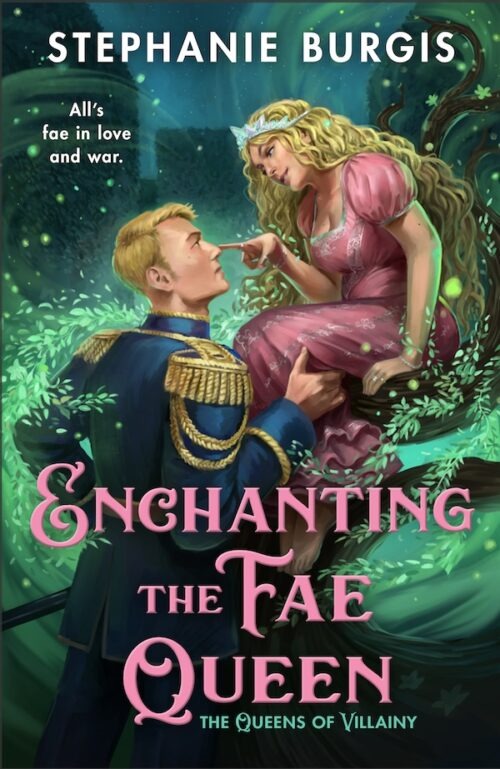
When you are trying to find femdom books, while some things tag themselves explicitly, a lot more of what is out there hides in plain sight. You have to either read everything and hope to be surprised or try to make educated guesses from the subtext inherent in a book’s premises or the cover art. This review is a follow up after an unexpected find, the next book in a series “The Queens of Villainy”, and I preordered it almost immediately finishing the preceding story, Wooing The Witch Queen.
Well, I’ve read it. Let the author enjoy her well deserved status on the USA Today best seller list for this book, but Enchanting the Fae Queen is not following up on the overt femdom themes of the last one. There’s a switch/primal thing being attempted here instead, which is many people will like, but not my cup of tea.
It’s a fluffy cupcake, full of banter and glitter and rapid fire fae perils. Other reviewers are showering it with stars and I absolutely won’t stand in their way. I hope Burgis continues to climb to a well deserved state of ongoing success.
Besides switching still shouldn’t entirely invalidate someone’s dominance just because they don’t do it all the time. And Burgis hardly promised this was going to be femdom, too. She only promised a captive male lead who is an uptight golden boy over-achiever virgin and you could argue I just got my hopes up too much. So, with that in mind, here is my own opinion of what is wrong here, outside of just the fact that I don’t like male dominance.
Most notably, I don’t think Burgis trusted her audience enough to make Lorelei have any unlikeable traits linked to anything the character excelled at. I feel like she had to make the character’s malice so ineffectual because she was worried the captivity plot would erode the potential space for consent, but accidentally replicated one of my major pet peeves with how sexism impacts the genre of romance. Female characters aren’t actually allowed to be competently bad or otherwise effectively mean, because writers fear audiences will think they are unredeemable more so than the same behaviour from a man.
I won’t say writers are obligated to pretend that isn’t a real bias when they consider creating a marketable work, but it does become immediately obvious whenever a female character is supposed to be dominant even part of the time. And it sucks.
Of course people are forever kidnapping each other in romances. Readers like a good forced proximity and peril story and it injects a frisson of darkness many people find titillating. However, because of the gendered way we assume characters are allowed to behave, when a male character kidnaps a female character he gets way more grace to be threatening. Of course his motives may vary. Sometimes he is a ruthless pirate. Or doing it for her own good to hide her from her real enemies. Or consumed with BDSM flavoured lust. Regardless, the captivity is always treated as a real peril and his capacity to do so is based on a recognized ability to handle himself and exert an actual ongoing threat.
When female characters kidnap male characters it’s almost always an immediate farce, full of whimsical misunderstandings and feminine embarrassment. Her motives always have to be noble, or at least coerced by outside forces and almost immediately things dissolve into a sort of baby voiced “gee mister I didn’t mean you any harm, honest I didn’t even know how guns worked when I shot you, aw shucks, don’t be maaaaaad”. Then the captive dude grudgingly comes to accept she doesn’t have a malicious bone in her body, she just got carried away, etc… but he is also at no point going to be more than surprised to find himself detained. Furthermore, once he realizes she is responsible, he will adopt a stern faced “little girl this prank has gone too far” attitude. She will blush and fume and stamp her little feetsies before ultimately coming to conclude the hero knows best.
As a dominant top who is here to get thrilled by the hero actually being bested and helpless, I am very used to being recommended toothless kidnapping farces, of which this is yet another unremarkable example. What I want is gender flipped Beauty and the Beasts, what I get is stories where men being abducted can’t really do more than be irritated because a woman did it. Burgis is writing in the YA space so there wasn’t going to be much real darkness to begin with, but if this book was trying for a powerful take-charge heroine it undermined her too much to make that feel remotely plausible.
Thus the intermittent bondage inflicted on the male lead is not quite enough to get over the way the heroine’s behaviour and reactions undermine things. Even when she has the upper hand she immediately starts whimpering that she doesn’t feel powerful because he is hot. I would say this was trying to make sure it strangled all elements of power exchange all together, but notably the hero is allowed to take her in his strong grip and fantasize about her reaction to being helpless to him without being overwhelmed by her beauty. When they are in opposition he simply isn’t scared, just inconvenienced, whereas she is constantly terrified by the idea he might get her off.
This extends to the characters’ behavior and reactions outside of the romantic parts. We are supposed to take her seriously, but Lorelei is just too childish for me to buy the “appearances can be deceiving” premise she’s been given as far as her frivolity being an act. She’s not playing it up, she really is an impulsive hot mess who shouldn’t be put in charge of a lemonade stand, much less be a head of state.
Although the story starts off with a show of her dramatic magics and her pulling off a surprise abduction of a VIP, it quickly loses that steam. Almost immediately the plot lands them in a death trap she needs the hero’s help to escape, but they are there entirely due to her own prior, somewhat baffling choices. Thus, the peril feels that if happens because she incompetent and over confident, rather than an unforeseeable curveball. Indeed, as if to drive this home, the narrative has her mention how she’s a victim of constant assassination attempts and treachery from Fae and mortal alike, but she’s genuinely caught flat footed that someone maneuvers against her while she drags a prisoner through a somewhat dubious team building scheme.
The queens part of the “Queens of Villainy” framing device is also getting pretty strained here too. Saskia, protagonist of Wooing The Witch Queen, does queen related activities that show that the day to day of her nation is deferred to a Prime Minister, but she’s still serving her nation by shoring up the magical defences. And there’s discussion of how her hereditary legitimacy is holding together a much more consensus bases compromise system. Meanwhile, Lorelei’s role as monarch of Balravia has moved her into whatever the Political Science version of sexy lamp territory.
We are told the throne was bitterly fought for, and that she had to take it to protect the Fae minority within its borders, but we don’t even get the skeleton of a plan for how she is achieving this. Is she veto-ing laws? Sending troops to suppress Fae hunters? Organizing faerie affirmative action programs to ensure diverse representation in the civil service? We will never know this. She is the queen in the very conservative Romantasy sense of right of birth followed by right by violence. Her dad made a deal with the Fae and Lorelei has imported Fae handmaids, so presumably Balravia has to listen to her. But this book could have easily made her just a powerful citizen of the country and nothing else would change about the story, particularly because she can just vanish for days at a time and her citizens don’t seem effected.
(Side note, as far as her only other act of leadership we see her barging into the party of a neighboring empire and terrorizing the other guests. We are told they deserve this for expelling their Fae population, but this is never framed as an if/then threat, just a show of power the guests react to with reasonable fear for their lives. This is very a Saturday morning cartoon level simplification, depending on a premise that these hoity toity Empire bigots won’t immediately read this as an act of war. C’mon Lorelei, Baron Midtier Moderate over there just pissed himself because he thought he was about to be ended by greenery. You think this is advancing equality? Your whole pitch is that you are telling them you are just having fun, so the magical equivalent of firing a gun into the air isn’t even tied to a stated grievance deeper than not being invited to a party. She’s supposed to be a champion of the downtrodden but her goal appears to be to make people think Fae are capricious lunatics.)
Otherwise, Lorelei does absolutely zero actual leading, whining even her closest advisors (who are also all fae for some reason) push her around. She has a seat at the table in an alliance, but has already fucked up with them in the last book. About the only relevance her monarch status really provides here is her petulant insistence that faeries in the Fae only realm use her title as Queen, not her title in their world as Princess. But, ultimately she’s still all Tiara and no Tax Policy.
Burgis has made the male lead, Gerard an ascetic virgin, and Lorelei’s an openly lusty hedonist, but any actual sexual interactions and she’s not doing anything remarkable with that experience while he already magically knows what to do with no real direction. This isn’t pulling off inverted expectations either, the narrative just doesn’t trust the heroine enough to actually have made any part of her supposed past sexual escapades rewarding.
And I think that’s the part I found most peeving. In a genre currently ruled by fanfic style tags as marketing, this book did promise certain things via its tropes and then failed to properly explore them.
I think Burgis was trying for her female lead being misrepresented as an overstated succubus due to slut shaming. Instead it kind of comes across as anti-sexual exploration. Lorelei has been hurt repeatedly by all past lovers while Gerard saved himself for reasons, as it turned out, included simple disinterest in anyone else as much as it being the right choice pragmatically. Because all her past lovers were false and murderous, Lorelei is supposed to be traumatized and closed off, whereas Gerard saved himself for his true love… and has zero sexual hang ups.
And Gerard (and what we should assume is based on his lifetime of experience with his trusty hand?) is written as veritable sex god. There’s ways to subvert the trope of blushing virginity, but from a first kiss that may very well be his first kiss ever he is doing the lip biting thing that really isn’t a rookie friendly maneuver. That’s just iffy writing. And nothing else is particularly plausible after that.
Wooing The Witch Queen was almost sexless, but this book’s couple does plenty of going at it on page. I am starting to wonder if the choice in the first book wasn’t to keep things YA friendly, but because either Burgis or their editor cannot imagine sex where the woman isn’t the one behaving like a cliché heroine who has never known such pleasure from a man (who incidentally knows her body better than she does). It’s very boilerplate sex. The progressive kind of boilerplate, where we make sure the reader knows her orgasm is a priority, but very box ticking nevertheless.
And another thing, since I think I am struggling to stay positive here and might as well get it off my chest… There’s only so many times Lorelei can break off their embrace with “no, I am actually too scared to do this because it feels good!” and then get gently put down again by the hero before you don’t want them to try again until they have an adult conversation. Likewise the narrative repeatedly reassuring us Gerard immediately stops goes from a hat tip to the importance of consent to worryingly repetitive that he needs to acknowledge in his own head he isn’t going to rape her.
Even outside of sex, Enchanting the Fae Queen is too eager to show how similar the characters are to actually let Lorelei be better than Gerard at anything that matters, even things she should far exceed him at. He knows about as much magical lore as she does, navigates the Fae realm as equally competently as someone who is one, and handles the other Fae about as effectively as she does. In his one moment of real vulnerability to Fae more so than her is really more of a her problem that she has to surrender to.
Meanwhile, Lorelei is not a good leader; not a particularly effective strategist; not particularly bright; not remarkably good at sex; and not really well respected even by technical peers. There’s a scene where the book compares her to a small animal desperately trying to protect babies, and maybe it was trying to get across that actually she had a heart of gold, but mostly it served to emphasize how her immaturity diminished her. She’s not a good person, she’s a smol bean who has been handed power by other people. This is a bad contrast against someone you built up as a self made genius. He overcame all odds and is stressed by the demands placed on him, but also self assured inside and out. She’s a scared, clingy baby telling us she’s only “pretending” to be extremely emotional. And lots is said about how it benefits her not to be taken seriously, but we never see that give her any advantage.
Now granted, there’s a scene at the end where the hero suddenly gets hit with the idiot stick and needs rescuing too. But, at that point Lorelei immediately turns to her other magical alliance besties to do most of the heavy lifting, concluding actually she needs to accept they are allowed to scold her like a junior member of the group if they are to help her. The story arc here is how the Queen of Fae learns to open herself up and accept other people will make good choices for her and how she very much never knows best by herself.
There a turn of phrase I like for what happened here, the Impossible Burger Romance (credit @thedextriarchy.bsky.social) where a writer tries a non-traditional premise, but is so concerned the readers won’t be happy with that they immediately veer back into doing the most traditional story they can. As a result this isn’t even a switch romance. This is a Daddy and brat story where Daddy likes to be consensually topped from time to time, even if babygirl feels shy when she does it. The book desperately wants there to be a girl power element, without trusting the heroine to have any real power of her own.
Sure, maybe that’s your thing, but it’s poison to writing even a part time power exchange dynamic and it’s not a stable enough foundation to pull off the nemesis part either. Lorelei’s not Gerard’s enemy, she’s, at best, a tsundere whose idea of plotting and international intrigue is a literal stink bomb. By book’s end she has his attention and Gerard’s bridges are duly burned with his own faction, what even are they going to banter about to play fight over?
In aggregate it delivers a light afternoon read where two characters bicker their way through a series of challenges while slowly succumbing to their desire for each other. That’s enough to sell a book. But as well as not delivering what I hoped it might, it’s also not enough to sell what it advertised it was trying to do. I think this is a pity because Burgis has been better when they stay non traditional and would have been a better book if they did that here too. I will finish things up with the third book when it comes out, but it won’t be with any raised hopes.
Where to buy: Enchanting the Fae Queen by Stephanie Burgis
Discover more from Miss Pearl
Subscribe to get the latest posts sent to your email.
2 thoughts on ““Enchanting the Fae Queen” by Stephanie Burgis [Femdom Book Review]”