
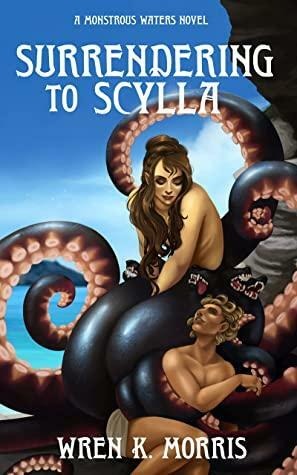
A cursed nymph living a life of violent retribution comes to love and be loved by a gentle, shipwrecked fisherman. She’s been hurt badly before, but through the power of his endless patience, a strong fawn response from his own prior trauma and the power of forced proximity, love is found (as well as general deference to her authority).
It’s a Greek myth retelling and monster romance, between Scylla, the sea monster, and a man who is like not like the other terrible men she has met before. He is patient enough with her prickly side to let her come to trust him, and he is devoid of the dominating masculinity of all her prior suitors. There’s lots of overtly coded, unapologetic femdom and a lot of feelings.
If you like your ladies strong and your men soft, and you want to watch the most bitter woman in the world be loved anyway, you may find this was just what you were looking for. There’s lots of action, tentacles and high drama, and pretty reasonable pacing. It’s even the first book of the series, rather than sticking the femdom in the ass end of the book list when all the creative juice is wearing thin. Unfortunately I didn’t personally find it worked for me, but I can see why people do, and what in it was done very well.
For positives, you get a heroine who is allowed to be physically monstrous, biblically accurate style. Scylla has tentacles aplenty and vicious dog heads at her waist, and rips several people in half. She is a Gothic villain in the style usually only permitted to male characters, the brooding brute. The plot is also constructed into a coherent narrative by someone who clearly knows their myths. A barren island’s cave system makes for a novel and occasionally oddly comfy setting. I liked the slice of life parts.
Unfortunately, for me, all this is held back by a chronically weak male lead (in more than the physical sense) and a cartoonish level of simplicity to its approach to the bad guys. And, as a modern retelling, for all it tries to tweak itself to a more feminist framing, with its emphasis on female rage, the rewards of being true to yourself while opening up a little to love are a bit dubious.
I also found it couldn’t seem to commit to how unlikeable the heroine is supposed to be. That’s not something I would call a fatal flaw. It’s well understood that female characters are held to higher standards to sweetness and thematically this is about not having to be nice. Nonetheless, there’s a bit of awkwardness in how much we the reader are supposed to buy her self justification. Retellings of the villain figure stories often struggle with this, explaining away what modern audiences might particularly take issue with to the point of dilution or failing to address them satisfactorily. While the Greeks themselves gave most popular characters in their stories different interpretations that could be completely contradictory, I found Surrendering to Scylla a bit tonally indecisive in how bad it wanted her to be read as. Greeks often elided around that problem with tragedy, of which this would otherwise stand well as, but Romances have to give you a Happily Ever After. Unfortunately, this one tried to do so without deciding if the characters needed to resolve or soften most of their flaws, or lean into them.
So, we linger on Scylla’s suffering to make her understandable, first her objectification as a nymph, her status as collateral damage to a deluded Circe, and so on. Usually this sort of framing is done to make a character’s behavior understandable and sympathetic. Inversely, she has an awful lot of self pity for a serial killer and very little self reflection about her own prejudices around other monsters. The story also acknowledges that she is actively luring people to their death for the crime of being in the same zipcode and not as discriminating a killer as she puts herself to be. Morris isn’t going for the me-or-them completely misunderstood monster. I actually liked this part, but her unchanging embrace of that came at the expense of Ophelo’s likeability in a way that I don’t think was intended. It also ends up highlighting how simplified all the other characters are in their uncritically described awfulness, which can be confusing.
Because additional characters are left in very reductive shapes, it’s very undecided about what I would describe as how much we should take seriously the leads’ trauma goggles. Narrative seesaws between hints of complexity and hard binaries, where people are all good or all bad. It therefore feels a bit like we are getting things through the perspective of our two leads, but not given space to acknowledge they are unreliable narrators.
For example, in the setting “Sailors” are officially distinct from the male lead, a “Fisherman”. The former is a sort of long voyaging traveller, the latter, we are led to understand, is a skilled trade everyone spits on. Why do Sailors sail? Scylla would say they are greedy, but stops short of saying they are all raiders. They have treasures on their boats sometimes. That’s about the level of motivation we get here, so we can only infer most of them are traders. Regardless, Sailors are all characterized as absurdly awful, murderous jerks. Some of this is being played for laughs, with how ridiculous the characters are. But at the same time we are supposed to see them as a real danger to Ophelos, including implications (off page) he has been repeatedly sexually assaulted. Thus, the book struggles with the nuance it wants to insert.
Scylla has a massive blind spot where her interactions with the world essentially amount to avoiding Gods and being exasperated strange horrid Greek men want to fuck her. She’s clearly never thought about any mortal who wasn’t cut in the heroic measure, and while those that do have nothing to recommend them, those that don’t are largely outside of her interests.
For example, she is hard done by and alone thanks to the curse. But she also keeps mentioning off hand there’s another monster in line of sight from her own home that she has clearly made zero effort to contact. We never learn why, but she is also offended to be compared to other monsters without a lot of caveats on Ophelos’s part. This isn’t one of those “monster is our word, you can’t use it” either. She just blithely assumes that her neighbour isn’t worth talking to.
Ophelos, on the other hand, is comically bullied. He is so bullied, the story makes it clear that even his father was bullied. Everyone bullies him so hard and so mean, but he kills and catches fish so good that the Sailors brought him along in the boat. The rest of his character is basically one giant trauma fawn response. When he isn’t fawning he is clinging. The clinging is framed as the courage of his love, but given the other thing we know is the only people who didn’t bully him were older women he helped in the past, there’s a streak of self preservation here that never gets addressed. And nonetheless, his actual backstory is life in a small village followed by travel with horrid louts. For all his time on boats he has never seen the world without bringing a gang of assholes with him wherever he goes.
While Sylla is permitted to do things female characters usually don’t get to, Ophelos’s most positive trait is his complete inability to pose any meaningful threat to Scylla. This makes her feel safe, but ultimately that’s all he can offer. It feels like in an effort to emphasize the distinction between them it ends up giving Scylla depressingly low standards.
Ophelos embodies that observation that if you are the sort of person who waxes at length that dogs are better that people, what you mean is you prefer beings you have all the power over who depend on you completely. It’s not wrong to fantasize about making someone into your literal emotional support pet. It just made it hard for me to feel Scylla was actually getting a good deal.
I think my “come the fuck on” moment with this book was probably the relationship’s third real conflict. After an interlude of innocent-in-a-Gothic-castle style standard warming to each other, a gang of Sailors show up and attempt to fight Scylla. Ophelos wanders into this, and, after the Sailors’ offer of rescue is rejected by him, turns on Ophelos as well. As is a traditional trope, Scylla takes a mild injury defending him, but when she is snuggling him in the aftermath he is also not comfortable with the carnage he just witnessed and blurts out he forgot she was a monster. Scylla reacts by storming off, rejection sensitivity dysphoria personified. When they both cool off, Scylla apologizes for not realizing gore could be off-putting… and Ophelos apologizes for letting his empathy get in the way of her murder and making her feel bad that he was openly upset. Even though, he says, he can’t help noting those dudes she ripped asunder could have easily been him, he knows she needs to do this as a part of herself.
Not “you were only protecting yourself and me!” Not “you couldn’t help it, you lost control” or even “yes, it’s bad but your monster part needs to feed”. Just that this is important to her, so who is he to get in her way or question that? We see that Ophelos fully acknowledges that Scylla is a monster in the behavior sense not the physical sense. It’s this point that we realize just how cooked this young man’s brain is. Supposedly soft, gentle and almost cloyingly sweet Ophelos is very bought into his role as a barnacle on bad people.
Scylla can kill a thousand other Ophelos, in his mind, as long as he gets to stay by her side. He doesn’t even characterize the victims as bad people, they just aren’t him so it is not his business. His thought process is that he believes he has to be with a monster anyway and at least this one loves him and confines the violence to others. Ditto, we are supposed to take Ophelos’s repeatedly refusing to be sent away as a strength of his devotion and character. He is just more scared of being alone and losing Scylla’s angry defensive energy. Ophelos isn’t nice, he is a Nice Guy.
I think why this galled me is that I spend a lot of time around people with a lot of overt female rage, and have had a fair bit of it myself. I am often spikey and bristle easily. And one thing you have to be mindful of is that there’s a category of Not Like Other Boys that will sort of remora onto women they see as having more fight than them. And notably they tend to conflate ability to be mildly helpful to people and a lack of their own ability to express agency as being inherently more good and thus above reproach (and more worthy of you). Ophelos gave up trying to be meaningfully good a long time ago, and his frightened reaction is supposed to be a momentary lapse he will try hard to get over.
There’s a bit in the last third of the book where she’s temporarily restored to a nymph and they maintain their D/s dynamic. Normally I would find that refreshing, as often resolving the plot’s source of conflict in a femdom story ends the dynamic. Unfortunately Ophelos’s unaddressed trauma and perpetual identity of victimhood dilute its impact. Scylla the nymph is still stronger than Ophelos, because his level of ability to stand up to her begins and ends with requesting that she only call him Pet during play (and not leave him alone). You get the clear impression that even subtracted from her physical augmentation, if she wanted to she could still take him to the tideline and hold him under water until the bubbles stopped. The part of her that made her a monster is also still there, even if the tentacles are temporarily back to legs. And, ultimately, they are basically living in a rental owned by her divine dad at this point. He might have insisted this is where he wanted to be but the alternatives have been clearly spelled out as death or more Sailor based abuse.
I also think the other point of hesitation for me is that in femdom circles there’s a tendency to be uncritical about the motivation for doing sadomasochistic hijinks is only just retribution for the pain of living under patriarchy. As a fantasy flavour it is no worse than say, pretending to be a pirate. As a thing to wade through though from people being serious, it’s basically the constant message that femdom is just another trauma induced personality disorder. Not that the drama of trauma can lead to accidental fetish material, but there’s a slice of the larger community who are doing this because they sincerely see it as a compromise needed to deal with the hazards of heterosexuality.
If Scylla, given choice, is still the monster, I would have also liked to have seen how Ophelos handled choice more meaningful than “noooo, I want to be with yooooooou” when confronted by separation others chose for him. Morris was probably being true to the myth here, in so much that there wasn’t any material to build out from, but at least once it would be nice to see him choose her when the alternatives weren’t objectively and unambiguously more crap.
Nevertheless, being fair, this is a fantasy not a relationship guide. If Ophelos is little more than the rescue dog that encourages a traumatized woman to finally leave the house, that’s still an interesting story. And sometimes the best a real happy ending can offer us is living in a different, better house, and still with the good dog. Sometimes we don’t get over our bullshit or address our internal contradictions. And, I mean, come on, there’s graphic alien physiology monster sex. And captivity based femdom that stays femdom post captivity. And a happy ending that pleases the characters, even if it might not be perfect.
Discover more from Miss Pearl
Subscribe to get the latest posts sent to your email.
Hi Miss Pearl. Having read some of Ms Rika’s books, I was wondering if you could recommend other books with a similar approach but also covering those “areas of concern” you mention. Thanks!