“Enchanting the Fae Queen” by Stephanie Burgis [Femdom Book Review]

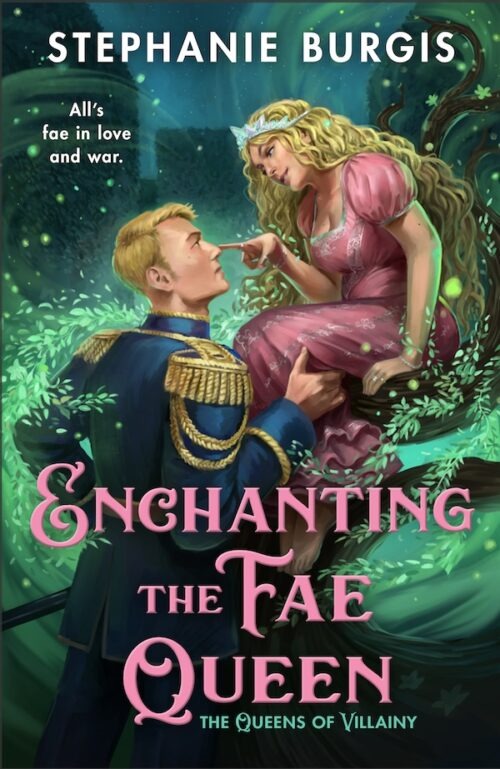
Enchanting the Fae Queen by Stephanie Burgis cover. It shows a blonde woman in a princess dress booping the nose of a blond man in a blue military uniform. The tagline is "All's fae in love and war"

When you are trying to find femdom books, while some things tag themselves explicitly, a lot more of what is out there hides in plain sight. You have to either read everything and hope to be surprised or try to make educated guesses from the subtext inherent in a book’s premises or the cover art. This review is a follow up after an unexpected find, the next book in a series “The Queens of Villainy”, and I preordered it almost immediately finishing the preceding story, Wooing The Witch Queen. 

Well, I’ve read it. Let the author enjoy her well deserved status on the USA Today best seller list for this book, but Enchanting the Fae Queen is not following up on the overt femdom themes of the last one. There’s a switch/primal thing being attempted here instead, which is many people will like, but not my cup of tea. 

It’s a fluffy cupcake, full of banter and glitter and rapid fire fae perils. Other reviewers are showering it with stars and I absolutely won’t stand in their way. I hope Burgis continues to climb to a well deserved state of ongoing success.

Besides switching still shouldn’t entirely invalidate someone’s dominance just because they don’t do it all the time. And Burgis hardly promised this was going to be femdom, too. She only promised a captive male lead who is an uptight golden boy over-achiever virgin and you could argue I just got my hopes up too much. So, with that in mind, here is my own opinion of what is wrong here, outside of just the fact that I don’t like male dominance. 

Most notably, I don’t think Burgis trusted her audience enough to make Lorelei have any unlikeable traits linked to anything the character excelled at. I feel like she had to make the character’s malice so ineffectual because she was worried the captivity plot would erode the potential space for consent, but accidentally replicated one of my major pet peeves with how sexism impacts the genre of romance. Female characters aren’t actually allowed to be competently bad or otherwise effectively mean, because writers fear audiences will think they are unredeemable more so than the same behaviour from a man. 

I won’t say writers are obligated to pretend that isn’t a real bias when they consider creating a marketable work, but it does become immediately obvious whenever a female character is supposed to be dominant even part of the time. And it sucks. 

Of course people are forever kidnapping each other in romances. Readers like a good forced proximity and peril story and it injects a frisson of darkness many people find titillating. However, because of the gendered way we assume characters are allowed to behave, when a male character kidnaps a female character he gets way more grace to be threatening. Of course his motives may vary. Sometimes he is a ruthless pirate. Or doing it for her own good to hide her from her real enemies. Or consumed with BDSM flavoured lust. Regardless, the captivity is always treated as a real peril and his capacity to do so is based on a recognized ability to handle himself and exert an actual ongoing threat. 

When female characters kidnap male characters it’s almost always an immediate farce, full of whimsical misunderstandings and feminine embarrassment. Her motives always have to be noble, or at least coerced by outside forces and almost immediately things dissolve into a sort of baby voiced “gee mister I didn’t mean you any harm, honest I didn’t even know how guns worked when I shot you, aw shucks, don’t be maaaaaad”. Then the captive dude grudgingly comes to accept she doesn’t have a malicious bone in her body, she just got carried away, etc… but he is also at no point going to be more than surprised to find himself detained. Furthermore, once he realizes she is responsible, he will adopt a stern faced “little girl this prank has gone too far” attitude. She will blush and fume and stamp her little feetsies before ultimately coming to conclude the hero knows best. 

As a dominant top who is here to get thrilled by the hero actually being bested and helpless, I am very used to being recommended toothless kidnapping farces, of which this is yet another unremarkable example. What I want is gender flipped Beauty and the Beasts, what I get is stories where men being abducted can’t really do more than be irritated because a woman did it. Burgis is writing in the YA space so there wasn’t going to be much real darkness to begin with, but if this book was trying for a powerful take-charge heroine it undermined her too much to make that feel remotely plausible. 

Thus the intermittent bondage inflicted on the male lead is not quite enough to get over the way the heroine’s behaviour and reactions undermine things.  Even when she has the upper hand she immediately starts whimpering that she doesn’t feel powerful because he is hot. I would say this was trying to make sure it strangled all elements of power exchange all together, but notably the hero is allowed to take her in his strong grip and fantasize about her reaction to being helpless to him without being overwhelmed by her beauty. When they are in opposition he simply isn’t scared, just inconvenienced, whereas she is constantly terrified by the idea he might get her off.

This extends to the characters’ behavior and reactions outside of the romantic parts. We are supposed to take her seriously, but Lorelei is just too childish for me to buy the “appearances can be deceiving” premise she’s been given as far as her frivolity being an act. She’s not playing it up, she really is an impulsive hot mess who shouldn’t be put in charge of a lemonade stand, much less be a head of state. 

Although the story starts off with a show of her dramatic magics and her pulling off a surprise abduction of a VIP, it quickly loses that steam. Almost immediately the plot lands them in a death trap she needs the hero’s help to escape, but they are there entirely due to her own prior, somewhat baffling choices. Thus, the peril feels that if happens because she incompetent and over confident, rather than an unforeseeable curveball. Indeed, as if to drive this home, the narrative has her mention how she’s a victim of constant assassination attempts and treachery from Fae and mortal alike, but she’s genuinely caught flat footed that someone maneuvers against her while she drags a prisoner through a somewhat dubious team building scheme. 

The queens part of the “Queens of Villainy” framing device is also getting pretty strained here too. Saskia, protagonist of Wooing The Witch Queen, does queen related activities that show that the day to day of her nation is deferred to a Prime Minister, but she’s still serving her nation by shoring up the magical defences. And there’s discussion of how her hereditary legitimacy is holding together a much more consensus bases compromise system. Meanwhile, Lorelei’s role as monarch of Balravia has moved her into whatever the Political Science version of sexy lamp territory. 

We are told the throne was bitterly fought for, and that she had to take it to protect the Fae minority within its borders, but we don’t even get the skeleton of a plan for how she is achieving this. Is she veto-ing laws? Sending troops to suppress Fae hunters? Organizing faerie affirmative action programs to ensure diverse representation in the civil service? We will never know this. She is the queen in the very conservative Romantasy sense of right of birth followed by right by violence. Her dad made a deal with the Fae and Lorelei has imported Fae handmaids, so presumably Balravia has to listen to her. But this book could have easily made her just a powerful citizen of the country and nothing else would change about the story, particularly because she can just vanish for days at a time and her citizens don’t seem effected. 

(Side note, as far as her only other act of leadership we see her barging into the party of a neighboring empire and terrorizing the other guests. We are told they deserve this for expelling their Fae population, but this is never framed as an if/then threat, just a show of power the guests react to with reasonable fear for their lives. This is very a Saturday morning cartoon level simplification, depending on a premise that these hoity toity Empire bigots won’t immediately read this as an act of war. C’mon Lorelei, Baron Midtier Moderate over there just pissed himself because he thought he was about to be ended by greenery. You think this is advancing equality? Your whole pitch is that you are telling them you are just having fun, so the magical equivalent of firing a gun into the air isn’t even tied to a stated grievance deeper than not being invited to a party. She’s supposed to be a champion of the downtrodden but her goal appears to be to make people think Fae are capricious lunatics.)

Otherwise, Lorelei does absolutely zero actual leading, whining even her closest advisors (who are also all fae for some reason) push her around. She has a seat at the table in an alliance, but has already fucked up with them in the last book. About the only relevance her monarch status really provides here is her petulant insistence that faeries in the Fae only realm use her title as Queen, not her title in their world as Princess. But, ultimately she’s still all Tiara and no Tax Policy. 

Burgis has made the male lead, Gerard an ascetic virgin, and Lorelei’s an openly lusty hedonist, but any actual sexual interactions and she’s not doing anything remarkable with that experience while he already magically knows what to do with no real direction. This isn’t pulling off inverted expectations either, the narrative just doesn’t trust the heroine enough to actually have made any part of her supposed past sexual escapades rewarding.

And I think that’s the part I found most peeving. In a genre currently ruled by fanfic style tags as marketing, this book did promise certain things via its tropes and then failed to properly explore them. 

I think Burgis was trying for her female lead being misrepresented as an overstated succubus due to slut shaming. Instead it kind of comes across as anti-sexual exploration. Lorelei has been hurt repeatedly by all past lovers while Gerard saved himself for reasons, as it turned out, included simple disinterest in anyone else as much as it being the right choice pragmatically. Because all her past lovers were false and murderous, Lorelei is supposed to be traumatized and closed off, whereas Gerard saved himself for his true love… and has zero sexual hang ups. 

And Gerard (and what we should assume is based on his lifetime of experience with his trusty hand?) is written as veritable sex god. There’s ways to subvert the trope of blushing virginity, but from a first kiss that may very well be his first kiss ever he is doing the lip biting thing that really isn’t a rookie friendly maneuver. That’s just iffy writing. And nothing else is particularly plausible after that.

Wooing The Witch Queen was almost sexless, but this book’s couple does plenty of going at it on page. I am starting to wonder if the choice in the first book wasn’t to keep things YA friendly, but because either Burgis or their editor cannot imagine sex where the woman isn’t the one behaving like a cliché heroine who has never known such pleasure from a man (who incidentally knows her body better than she does). It’s very boilerplate sex.  The progressive kind of boilerplate, where we make sure the reader knows her orgasm is a priority, but very box ticking nevertheless. 

And another thing, since I think I am struggling to stay positive here and might as well get it off my chest… There’s only so many times Lorelei can break off their embrace with “no, I am actually too scared to do this because it feels good!” and then get gently put down again by the hero before you don’t want them to try again until they have an adult conversation. Likewise the narrative repeatedly reassuring us Gerard immediately stops goes from a hat tip to the importance of consent to worryingly repetitive that he needs to acknowledge in his own head he isn’t going to rape her.  

Even outside of sex, Enchanting the Fae Queen is too eager to show how similar the characters are to actually let Lorelei be better than Gerard at anything that matters, even things she should far exceed him at. He knows about as much magical lore as she does, navigates the Fae realm as equally competently as someone who is one, and handles the other Fae about as effectively as she does. In his one moment of real vulnerability to Fae more so than her is really more of a her problem that she has to surrender to. 

Meanwhile, Lorelei is not a good leader; not a particularly effective strategist; not particularly bright; not remarkably good at sex; and not really well respected even by technical peers. There’s a scene where the book compares her to a small animal desperately trying to protect babies, and maybe it was trying to get across that actually she had a heart of gold, but mostly it served to emphasize how her immaturity diminished her. She’s not a good person, she’s a smol bean who has been handed power by other people. This is a bad contrast against someone you built up as a self made genius. He overcame all odds and is stressed by the demands placed on him, but also self assured inside and out. She’s a scared, clingy baby telling us she’s only “pretending” to be extremely emotional. And lots is said about how it benefits her not to be taken seriously, but we never see that give her any advantage.

Now granted, there’s a scene at the end where the hero suddenly gets hit with the idiot stick and needs rescuing too. But, at that point Lorelei immediately turns to her other magical alliance besties to do most of the heavy lifting, concluding actually she needs to accept they are allowed to scold her like a junior member of the group if they are to help her. The story arc here is how the Queen of Fae learns to open herself up and accept other people will make good choices for her and how she very much never knows best by herself. 

There a turn of phrase I like for what happened here, the Impossible Burger Romance (credit @thedextriarchy.bsky.social) where a writer tries a non-traditional premise, but is so concerned the readers won’t be happy with that they immediately veer back into doing the most traditional story they can. As a result this isn’t even a switch romance. This is a Daddy and brat story where Daddy likes to be consensually topped from time to time, even if babygirl feels shy when she does it. The book desperately wants there to be a girl power element, without trusting the heroine to have any real power of her own. 

Sure, maybe that’s your thing, but it’s poison to writing even a part time power exchange dynamic and it’s not a stable enough foundation to pull off the nemesis part either. Lorelei’s not Gerard’s enemy, she’s, at best, a tsundere whose idea of plotting and international intrigue is a literal stink bomb. By book’s end she has his attention and Gerard’s bridges are duly burned with his own faction, what even are they going to banter about to play fight over? 

In aggregate it delivers a light afternoon read where two characters bicker their way through a series of challenges while slowly succumbing to their desire for each other. That’s enough to sell a book. But as well as not delivering what I hoped it might, it’s also not enough to sell what it advertised it was trying to do. I think this is a pity because Burgis has been better when they stay non traditional and would have been a better book if they did that here too. I will finish things up with the third book when it comes out, but it won’t be with any raised hopes. 


Where to buy: Enchanting the Fae Queen by Stephanie Burgis

“His Secret Illuminations” by Scarlett Gale [Femdom Book Review]

The TL;DR for this one is that a physical difference (big streetsmart warrior woman/small booksmart mage) forms our starting premise for an opposites attract dynamic to blossom in some cozy adventuring fantasy. Why it’s good is entirely in the execution, and its runaway popularity for an indie is a good thing to point to whenever anyone says femdom books are not marketable. It deserves the love it gets, and in further emphasis of its merits, if you extracted any of the overt kink or romance elements it would still stand on its own without them.

Although I actually read His Secret Illuminations several years ago, back when it came out, I am using the purchase of the physical books as my excuse to finally get around to gushing about my enjoyment of them, and of course giving it a re-read.

Our protagonist, Lucien, is a monk, from an isolated monastery from the most hardline version of his sect. That sect has hired Glory of the Snow, a massive, blonde and vaguely Viking coded woman, to retrieve some stolen books. She’s worked with the monastery before on smaller quests, giving the couple time to have a meet cute and establish a bit of mutual interest, but the need for retrieving the Macguffin gives a convenient impetus to throw them together. Glory, for all her fighting prowess, lacks the magic Lucien has that will let him track and correctly identify the missing items. This, in turn, throws him well out of his comfort zone, both having to navigate his extreme sexual repression and figuring out how to function in a world where every choice is no longer made in service to the monastery.

As far as the fetishes being indulged here, Gale does a good job with playing with the fantasy of Lucien’s extreme innocence and naivety well for self indulgence purposes, but without tripping into being tedious or making one unduly concerned about his ability to consent. Importantly, for those of you who may hesitate because of the number of strangers who keep calling you Mommy uninvited, at no point does it ever stray into making him full on hobosexual-helpless. The fantasy here isn’t about him being without life coping skills, rather giving a way to gender bend the princess-in-the-tower trope. And to justify a nearly stratospheric amount of yearning on the male lead’s part. 

Inversely, Glory’s endless well of patience still manages to remain a power fantasy for a dominant reader, because a great deal of emphasis is put on making Glory a complete person and giving Lucien lots of opportunities to show his use to her. She is allowed to be appreciated for what she is good at, and the falling in love part on her side is essentially discovering just how rapidly he gets up to speed and is then able to keep up with her. The premise is opposites attract, yes, but the conclusion is competence likes competence, even if this can take many forms. Likewise how the other characters react to the budding romance also makes it clear that Lucien and Glory are each other’s type, but it’s not making any sort of fundamental judgment that only these two could truly love each other, or their ability to appreciate each other is some sort of virtue.

The overt femdom elements likewise flow very naturally, in so much that there’s an almost mirror scenario going on that the more comfortable Lucien gets with the outside world, the more intensely we get to see him yearn to be mauled and pinned by Glory. Thus, while the couple doesn’t actually bang until the very last chapter, by the second half of the book the spice has started to seriously kick in. Using Lucien here as the perspective character seems to mostly be because the reader is assumed to want to focus most closely on all the horny submissive vulnerability he is giving off.  

As far as the sex scenes, I would describe them as a natural continuation of the overall themes of exuberant self discovery. The whole book is an immersive sensory experience with a lot of emphasis on embracing the whole body, just as much through food, bathing, clothes and physical activity. Inversely, the real conflict of the book is largely internal. Though there’s many smaller adventures along the way, from medical emergencies to heists, Lucien’s main struggle is with religious guilt, and its typical over emphasis on discomfort and deprivation. 

The way Glory is constructed and how we are allowed to get to know her is also extremely refreshing. Fetishization is often synonymous with objectification, and the larger culture we live in struggles with the idea of a dominant woman as an anomaly. All too often fictional female dominants can veer into becoming avatars of inspiration more so than human beings. This can be particularly the case when the domme character’s role is as a guide (or an antagonist). Sometimes you counter balance this by giving her a challenge of her own to surmount, but inversely this can lead to these characters being stuck being incomplete until the sub comes along. Glory is fine. She doesn’t need a partner not as an act of bitter rebukement, and she has enough openess to others Lucien can have a reciprocal relationship, but we absolutely avoid any hint of feeling ashamed, freakish or rejected without reducing her down to some sort of inexplicable force of nature.

I don’t mind stories of overcoming the world’s efforts to make women small, submissive and compliant, but while there is one scene where those pressures are explored as a potential hazard the book otherwise goes out if its way to make sure you know that’s more of a minority opinion among the citizens of the world. Sometimes, as a dominant reader you need a break from being told you are a freak, even a virtuous one, you know?

I also think it’s worth talking about how much this intersects between wish fulfillment and the mundane beliefs of the culture that produced it. As much as you could call this a Romantasy, it’s equally on the spectrum of being a LitRPG. That’s not to say that the characters have explicit game style overlays and talk about their abilities in terms of levelling up, but the strongest influence here on the setting and plot is on the norms we accept from fantasy TTRPGs. That’s a world where we accept that “adventurer” is a job, where people doing that job have specialized roles like Fighter or Wizard. Likewise, the story is told through an alternation of giving the character a challenge to solve as a group and a period to rest and improve their skills and gear. Thus, tonally what you are getting here benefits from giving you the vibes of playing a very interesting roleplaying game without but without any of the mechanical elements of the game intruding on the story it’s trying to tell or requiring any familiarity with the hobby.  


This choice of medium is ideal for the sort of story Gale is trying to tell. Most obviously, the premise depends on the fact that the game systems that influenced it decided to move away from default sexism baked into the mechanics of the game (for example avoiding adding gender based penalties or bonuses). The other reason is one that gets less spoken of. The elements that make a game function overlap so much with how modern kinky people get up to their shenanigans that the latest edition of The Dungeon Master’s Guide opens with instructions on how to conduct a consent negotiation one could practically lift unchanged and use in a much more intimate context. This cross pollination is intentional and direct, a symptom of the observation that the Venn Diagram between nerdy and creative hobbies and the people who do BDSM is essentially a circle.

For His Sacred Illuminations, therefore, not making your characters approach the ethos of sex like a kinky person would be weirder than the fact that they do. So, as a result, everything works.

Lasty though, I will flag that Gale has actually split things into two books. His Sacred Incantations finishes the couple’s overall story, but the ending of the first and second parts is much more a matter of the pragmatics of serialization than any real completed story arc in the first volume. You could argue that you have reached the traditional romance part’s conclusion by the end of book 1, and book 2 is more about drawing you deeper into the world, but I believe book 2 is just important for what it is trying to do, which, having set up the dynamic between the characters we now get to see it in action.

I think that’s particularly important, given that their initial dynamic is built on setting based power imbalances, whereas in book two we get to see the dynamic run on a firmer foundation of mutual reliance. If you are willing to take the risk on it, buy both books in one go.


Where to get your own copy: Author’s website, directly.

“Dominating Mr. Darling” by Victoria Vale [Femdom Book Review]

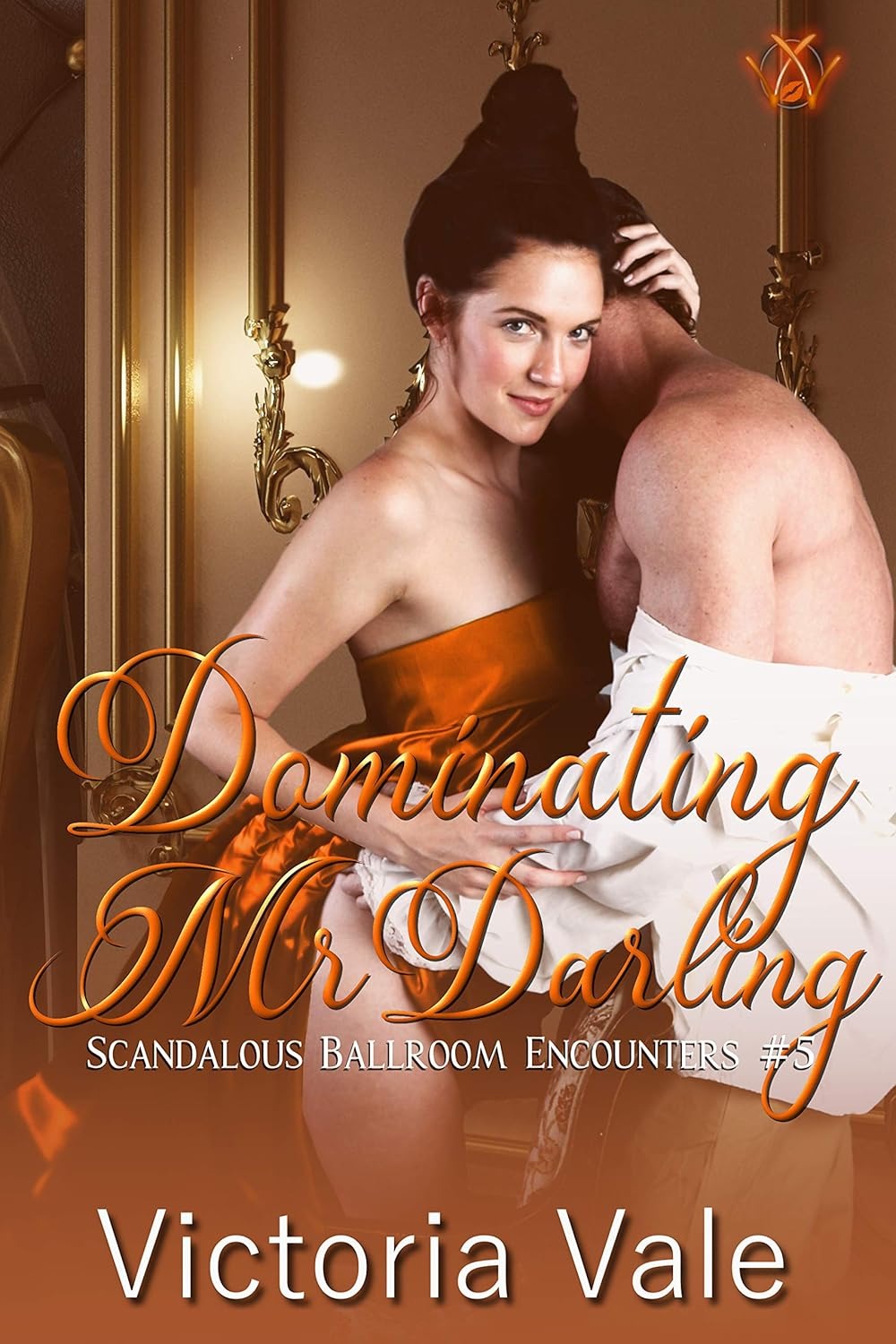
Dominating Mr. Darling by Victoria Vale, a cover showing a woman in an orange dress smiling as her arm is wrapped around a man half out of a loose white shirt.

Well, they can’t all be winners, I guess? Although “The Damsel” by the same author is probably on my short list for favourite works out of everything I have reviewed so far, “Dominating Mr. Darling” by Victoria Vale definitely isn’t.  Honestly, it’s pretty bad. A bait and (literal!) switch storyline; an actively annoying male lead; and a tendency to contradict its own premises mean I just didn’t like this one, and I don’t think most people will either.

As far as plot, here’s the jist: She’s the sister to the nobility, an heiress with an immense dowry. He is a mere mister with a bankrupt farming concern that desperately needs an infusion of capital. She’s an experienced dominant, but though he has never done anything like this before he quickly becomes immersed in her world. The book sells itself as a Domme (Lady Amelia Fitzwilliam) finally finding the perfect sub for her (the titular Mr. Darling), in an erotic historical romance setting. What you actually get is not that. 

Instead, this is about a woman who normally identifies as a dominant learning to love and be vulnerable through her submission to the male lead. While it implies that after this she goes back to being dominant with him, the book doesn’t trust the premise enough to allow her self discovery to be possible through someone else’s submission. If you were buying this based on the implications of the title and blurb, you are going to be disappointed. 

If you are the sort of person who is specifically seeking books with femdom in them, you are going to hate the book based on that problem alone. Perhaps unique of all groups, because of the normative pressures against women being dominant or men being submissive, we tend to be extra sensitive to anything that implies this is a phase, a facade or otherwise lacks a full emotional range.

Even so, sometimes even a serious flaw like that can just be an error in marketing. However, none of the other pieces of Dominating Mr. Darling come together well, either. Not the depictions of BDSM; not pulling off the stakes of the conflict; and not the figleaf of a historical setting. Each individually doesn’t work well, and in combination only serves to emphasize the flaws of the other parts. 

Of course, romance has always had a fuzzy attitude towards historical accuracy, treating it as negotiable. For every Flowers from the Storm, you are going to get a dozen Bridgertons. That’s not a bad thing, sometimes the past is just an excuse for pretty ballgowns or certain kinds of drama, and we aren’t here for the other stuff. And BDSM romances often take liberties too, favouring interesting conflicts over being strict manuals of how to kink responsibly. This is a feature not a bug. There’s room for books about healthy BDSM as just how the couples connect, but not all fantasies need to be diegetic good representation.

But, where Dominating Mr. Darling pairs vaguely Regency tropes (balls, social season, titles, marrying for money by default) with contemporary assumptions about how BDSM works (safewords, leather corsets), both feel like they were sort of counting on the other part to compensate for any compromises made. 

The historical setting gives us some costuming and a smattering of aesthetics. But, otherwise, for most of the book this really could have been about contemporary ultra rich people and nothing would have changed. Our heroine is an heiress who hangs out in men’s wear in casinos and fairly openly takes lovers inside and outside her own social class. At the same time, she is described as being the belle of good society, going so far as to be called “the Incomparable” by the consensus of the other aristocrats. Because we are in historical land she does have to contend with pressure to marry and the implication that doing so is a more or less one way journey, but there’s basement dungeons and modern style sex parties just about everywhere. Thus, because there’s no actual teeth to any of the other draw backs fo the setting, the result makes her seem like a rebel without a consequence.

Inversely, for all it pays lip service to modern concepts of consent, the lack of practical understanding of theory would probably be better suited to one where the characters could plead ignorance due to time period. Either you are telling a story where your husband has full legal rights over you and this is about how you navigate that as a person who wants to dom OR you are telling a story where those rules don’t apply. But then if you do that you lose a lot of leeway for the people to be trash at the BDSM part, which this book depends on to drive the conflict. 

Which is to say even as a switch romance it still falls on its face. The hero is an idiot who repeatedly wildly over steps whenever he is in a dominant role. His first decision, when faced with an opportunity to take charge for an evening, is to try to use that for real world leverage (commanding her to marry him). His next jaunt at that is to force her to reveal her secret in the most traumatic way possible. The third time involves her stripping off her fetish gear style symbols of dominance for some sort of reconciliation, after he has demanded she not shut him out when he fucked up the prior time. At no point does anyone acknowledge just how ridiculous that is because the reader is supposed to see this behaviour as daring and romantic. He cares about her so much he will take big swings and big risks, forcing her to do what she secretly wants. 

Sure, that’s a common part of submissive fantasies, but even if you are looking to do that you need to actually reasonably sell the idea that the dominant has the skill to do that. Or even that she needed to be rescued from her false front. Obviously I have my own reader bias about the trope that dominant seeming women just need the right man to take them down, but it doesn’t even do this well either. 

Instead, the book hasn’t taken the time to set up a premise where she is making a distinction between a mistress persona and herself, or how much her wild child self presentation is actually a smoke screen. For example there’s absolutely no role conflict after he marries her and sets her to the high femme business of ornamenting his home. All her earlier casino crossdressing becomes irrelevant and she takes to her midbook rustication with nary a bit of tension. Inversely, despite the book wanting us to take him equally seriously as a dominant, it also doesn’t suggest any effort on his part to learn to do this safely or respectfully. Or even that he understands what he did has been consistently bugnuts. He is supposed to be brash, but mostly this just comes across as entitled. 

The book takes a lot of time to establish she took years of supervised instruction to dominate well (not something I even enjoy, but hey, that’s the book’s argument about how this works, not me), but two scenes later, both extreme disasters, and the hero is treated as on par with her for his ability to take charge. Not only does this make for an obnoxious character, it becomes just another facet of how Mr. Darling’s monumental ego is treated as a good thing, and Lady Amelia’s confidence is something to be disrespected.

It also struggles with a problem many romance novels do, when the universe conspires to undermine one of the characters and make it clear everyone else has collectively concluded any resistance on their part to the other lead is silly. Faced with ambivalence or issues, everyone is quick to remind Lady Amelia this guy is clearly different to her and this would be good for her. Any misgiving she has is treated like she just needs to open up her heart a little, every conversation with other characters and the dialogue always slides to how good the hero will be for her if she only stops trying to trust her own judgment. One conversation between the men later and Lady Amelia’s primary source of social protection, her brother, is completely won over and her to tell her why she really needs to go along with this Mr. Darling person. Even when he openly tells her brother the object of his affection has said no after a verify ham handed proposal. 

But we never see why Mr. Darling is different in a good way. Lady Amelia’s clearly found other subs to play with in the past. We get hints she’s struggled to find one eligible for class reasons, but we never actually learn why this guy is not like the other nobles and gentry. It seems to be trying to imply nobody else would ever bother to challenge her tsundere façade, but she is never given enough unreasonable prickles to pull that off. 

Nor do we really confront the fortune hunter aspect on Mr. Darling’s part, and how she gets treated like the hot piece of ass attached to some tempting investment capital. It’s used in a sex scene and they sort of bring it up as a bickering topic, but the narrative and dialogue of the other characters agree this is to be treated as petty on her part to consider it. The best angle we go for is that he was obviously going to marry wealthy, but she is a special money source, unlike any other heiress.  The benefit to Lady Amelia is supposed to be that she’s so traumatized by her past that only Mr. Darling can actually accept her and tear down her walls. But at no point is she unreasonably pushing people away. Actually she’s always written as being open to others and letting them please her. Past partners have not been given their walking papers for getting too close, she just has a lively history of causal sex.

Which might be the ongoing thematic issue, the over reliance on tropes doing the heavy lifting, and a very fanfic style presumption there’s automatic audience buy in. 

Fanfic often skips explaining or fully addressing character motives, because the audience already knows who they are and where the characters are coming from. Pregnant Batman discovering he is the Joker’s secret Omega only needs to explain how that differs from our existing assumptions about how that would go down. It tonally also trusts the audience is ok with everyone being keyed up. In the same way, genre fiction can sometimes get a little bit of leeway around this, for example we accept the past generally had more rigid gender roles. Nevertheless, when you use those expectations to try to frame everything out and then repeatedly act in contradiction to them you end up sounding incoherent. 

I think the best example of the book’s over reliance on cliché was when she’s just married the hero and is touring the dilapidated manor her heiress money is going to be used to fix up. While doing so, she meets his family and then when the couple continue away after that scene the hero says, gladly, how the place desperately needs a feminine touch. 

That’s a pretty common historical romance chestnut, the idea that a woman is the secret ingredient to turning a house into a home. Sure, if we are here to enjoy the love lives of titled nobility, what’s a little complementarian sexism in our fun pretend time? This is at least accurate to how they thought. Only, the book has so little interest in matching its tropes with what is on page that it never acknowledges that we also just met the hero’s mom, who lives in this house and has only been widowed for two years. This is her house too, presumably decorated and managed by her for the majority of her adult life. The mother is not depicted as incapacitated from domestic management either, they just aren’t rich enough to give the place a full turn over. Oh, and he also lives with his unmarried sisters, women who are ostensibly trained to do this domestic management too. But they don’t count. 

A better handling might examine this as ironic flattery, or confront how dismissive he is to the other women in his life, or even establish why domesticity isn’t their cup of tea. Or address how a woman who wants to flout society’s rules settles into playing literal homemaker without even an internal struggle. But this book is running like a check list. He doesn’t say it because this makes any sense, it’s because it’s an expected trope and the audience is presumed to want the vicarious interior design achievement fantasy as part of the setting. And because the other thing romances often offer is a ready made family who adores you, particularly one loaded with sequel bait characters, it also added the mom and sisters without really thinking over the implications on this book of why they were there. 

Looping back to my earlier criticism of the kinky bits, that problem of trope reconciliation also pops up in how incoherent it is over consent. The audience is presumed to want two things, the idea that BDSM is ok really (so we get modern safewords), but that it presents real danger (so we get coercive marriage proposals or just tossing a partner into subbing with little negotiation). We don’t unpack how surprise limit pushing is a bad idea, but we are supposed to accept it is reasonable to be upset. This is a world with safewords, but none of the other theory-of-CNC, like understanding people don’t always know to articulate limits. The second time the  hero causes a major problem through this, it almost seems like all the safety framing was actually supposed to undermine her for not speaking out in the moment, but then we immediately skip to the next trope, “if someone loves you they chase you” and off he goes after her. 

However, because we never addressed or properly set up any of the other parts going into that conflict, what we actually get is the female lead being cornered between the arbitrarily present misogyny of the vaguely historical setting (but only when it’s narratively convenient as a motive) and her own clumsily written self loathing. Here is another trope to check off, reassuring your lover they aren’t really damaged goods. That’s supposed to make him a good man, but it’s handled so poorly it basically comes across as him accepting her apology that he has repeatedly hurt her, and then her making one more sacrifice to reassure him she’s actually his. 

Thus the full narrative arc becomes: Woman with severe self worth issues covers it up with rebellion of society’s rules, but comes to surrender herself to a man who will tolerate she’s not easily submissive because she is hot and rich. Oh boy. When we get our happily ever after she’s supposed to go back to dominating him, but we are to understand she now knows her palace and will confine it to bedroom only topping while she spends the rest of their marriage paying for his new roof and curtains.

A few more thoughts…

As you might have guessed, I am tentatively embarking on a 2026 femdom book review project. This means, as long as I can endure it, one book a week, live on Sundays. The challenge with the pace I set for myself is that it means committing myself to efficiency, avoiding things ending in a DNF. It also means being willing to make negative reviews.

Previously, I had thought to avoid that, since there’s so few femdom books out there and the creator space is so much a poorly compensated labour of love that I was concerned this was going to act as yet another a caustic deterrent. On the other hand, I have determined that you, the reader, are capable of making the distinction between me disliking  a book and it being objective trash. And furthermore I decided that worse than reviewing a book negatively is never reading it at all. 

But, I also  think reading books you don’t like is actually helpful in figuring out what worked about the ones you did. At my most vain I think I am read by enough writers that articulating problems can also help with one of this project’s other problems. Femdom books a dominant might enjoy reading or are not necessarily written for specific kind of gaze many subs (of any gender!) find irksome aren’t really even established enough to be a coherent category people might market or create for. We have a huge problem of not only finding what we are looking for, but also articulating what we want in a way that reliably helps us get it.

So my criticism is also a matter of context. For example, Dominating Mr. Darling is a sequel to a prior book that was M/f, focusing on the heroine’s brother. Did it ask the dominant male lead of the prior book to formally submit to the heroine a bunch to reconcile his own icy heart? I strongly suspect it didn’t. At the same time, the prior book was also about opening yourself up to love after severe trauma, and we meet the hero of the last book as now being very meek and considerate around his wife.

So, narratively, Dominating Mr. Darling is also hitting another, more invisible problem in genre expectations. A lot of romance is actually a power fantasy about a person’s journey to success through making a more established or at least typically unassailable person bend to them due to the love they have for an otherwise weaker person. A lot of M/f romance does that, so do most books where a hero starts out through dint of setting or just sexism end with him crooning helplessly over the heroine, transformed by the power of love. And, honestly often the appeal of these characters (billionaires, peers-of-the-realm, vampires, etc…) is what their power can do for the other protagonist when properly harnessed.

When you start taking away bits of stereotype, which you have to do to tell a femdom story, you start seeing the cracks more. Even if this book was less of a mess, essentially trying to steamroll over its own writing with boilerplate genre expectations, you kind of struggle with the gender thing. Unless this is an else-world where anyone can be anything, the experience of having any gender is indelibly filtered through how sexism impacts you. Femdom is a niche apart from BDSM as a whole because the starting context of violating your enforced gender norms unavoidably alters how one experiences things. (That’s even if your experience is to assert you actually are just like the other male doms, you are still stuck having to do so)

A lot of femdom stories try to tell an inversion, a sort of role reversal. What if she was the one with all the power to start? Some don’t, for example Heather Guerre’s Preferential Treatment and What Was Meant to Be are more classic in the starting power dynamics. Either way, the whole category is still going to have choppy issues unless it acknowledges the role gender typically plays in romance. 

And I think F/m books struggle with the male lead as much as the female one. Even in books I otherwise liked, they often fail to deliver the idea that the man is a net positive in the happily ever after. Any romance can struggle to do that, of course, but because they often involve robbing the male lead of part of the toolkit he would normally have to prove his worth, a recurring thing I trip over in these books is you often think she is better off single.

And I think that’s what this book gave me. It helps me understand what I am looking for is an equal partner who can submit without being a sandbag. Whether a book can pull that off is probably going to be a big part in how much I feel it’s a satisfying HEA. And, to take this review back to where I came in, I suppose I would also like to talk about why The Damsel, by the same author, worked for me, but this one failed spectacularly.

On the face of it it should be a pretty similar arc. A couple meet in a kinky hookup where she initiates him through light bondage, and then he comes to understand her darkness inside. Both end with a softer, more vulnerable dominant. A fundamental difference, I think is not just that Vale avoided the incongruent check list tone of Dominating Mr. Darling, but also she trusted her characters more to do shit together that complimented each other. Her male lead wasn’t just offering understanding, but real help. And, inversely the help the heroine needed did not completely undermine her. 

The messages here, around dominance, also couldn’t be more different. In Dominating Mr. Darling, ultimately only submission is allowed to be true vulnerability. In The Damsel, submission is also strength and offering dominance is inherently expressing an act of trust in your partner. What I would therefore be interested to see is if Vale’s next F/m work leans more to the former or to the much more satisfying latter.


Where to get it: Dominating Mr. Darling

“Uniquely Rika” by Ms. Rika [Femdom Review]

Uniquely Rika Cover by Ms. Rika

While the bulk of my review efforts for this year intend to lean towards correcting the paucity of attention paid to femdom fiction (particularly romances), this week my chosen book is Uniquely Rika by Ms. Rika. It’s been sitting in my to-be-read pile for a while, a couple of years now in fact. Published in 2008, it’s generally on the short list of recommendations in online femdom spaces, alongside The New Topping Book, The New Bottoming Book, and The Mistress Manual. As far as placing it relative to those, it’s almost like The Mistress Manual’s aggressive opposite. It’s attempting to be a dominant pleasing first guide, for people who aren’t interested in replicating the stereotypical dungeon experience. Inversely, based on others’ comments, it’s also got a reputation for advocacy against standard practices to maintain consent. While there are some folks who treat it like their Bible, there’s many others with strong negative feelings in the other direction. That makes it popular, but controversial. 

Going into it, I was therefore curious about what to expect. Was this going to be alarming or were the criticisms overblown? Additionally, I had another piece complexity as a reviewer. I run in the same circles as Ms. Rika, at least on the internet, and in my arms length observation of them, they generally give well reasoned, patient advice. Therefore I also want to stress that my feelings about their guide are not a reflection on their overall capacity to advise people, and should be limited to this text. Inversely, as I will discuss further on the review, as a somewhat seasoned part of the kink community, I have some observations about what happened when this book’s advice was put into practice over the last 17 years. 

Uniquely Rika attempts to solve one issue: Dominants (or would be dominants) in F/m relationships are disproportionately dissatisfied, because they feel that how their role is presented to them prioritizes their partner’s gratification at the expense of their own. While everyone agrees a major cause of this is excessively pushy subs and a lopsided popular understanding of what is possible or how F/m works, this guide is part of the school of thought where the solution is to tell them this isn’t real submission, but also that a true sub is completely selfless. The best way to reflect this selflessness, in Rika’s mind, is constant 24/7 anticipatory service. 

Where the guide is weakest is that strictness of definition, and what I would describe of as having way more good faith on her part in the people trying to put her advice into practice. While it’s never a good idea in BDSM advice to talk about a true *anything*, her other major stumbling block is something she is pretty up front about in her forward. This is written for sub dudes trying to get their wife into this; vanilla women with a sub partner; and  generally kinky couples who are trying to transition intermittent play into a more encompassing dynamic. Nowhere in that list is solo dominant women, or dommes to whom this is their idea. This is an oversight that tilts things wildly, because the foundational premise leans to assuming that the dominant is starting from such a place of alienation that a sub needs to lean with all his weight in the other direction to over-correct past damage. And, if I am being honest, I find her approach to more traditional BDSM activities internally contradictory to how she frames them. 

To her credit, she makes it pretty clear this is just what works for her, in a sample size of 1, an, at the time of writing, 20 year 24/7 dynamic. That is not nothing, but she doesn’t claim a PhD in counseling psychology; a lit review of the 200 most useful books; or even makes anything bigger than claiming this is her perspective after a lifetime of observing other people’s dynamics fail to work. 

To place her ideas in the larger spectrum of what’s out there, she’s a Pyjama Domme (or fuzzy slippers Domme). That’s a byproduct of the late aughts to mid 2010s who collectively awakened to the problem that the conventionally understood idea of femdom was not working for most of us, since we weren’t interested in operating in a commercial context. Our actual problem was sexism (and remains so), and our mission to amplify ourselves and be heard was based on the very real need to assert that we did not need to wear a specific uniform of fetish wear and play a character to be permitted to do this. We particularly centered casual, deliberately unsexy loungewear as our symbols to emphasize this wasn’t about us performing for others. There were some significant upsides from this (omisspearl.com existing being one of them!), but Uniquely Rika also reflects some of the problems we were prone to.

At our worst, we could be very SWERFy, often lashing out more than needed at sex workers over the fact that we were immersed in the lock step advice that if you were a dominant and a woman/even vaguely femme, you needed to be an amateur dominatrix. To this day, we have both positives, but also a hard edge of a sort of heterofatalist tendency to throw a self defensive elbow in the direction of everything we have been historically harassed with, even as you aren’t prepared to give up on it entirely. That and the human tendency to simplify and ignore our own personal grey areas. A lot of dominants with criticisms of femdom culture will over state certain parts as being entirely the idea of silly and demanding men, while eliding over other parts we want to keep. 

For Ms. Rika, that probably shows up most in her effort to grapple with the idea of fetish versus vanilla. Everything femdom, in her cosmology, is either the false version of submission (summarized as that craving for a corseted, whip wielding, high camp goth disciplinarian) or “normal” female sexuality. Some of this is being deliberately hands off with trying to define specifics, in an effort to make this be more universal. But in practice, her efforts to illustrate why her method is more inviting flips into being a lot more specific than she seems to realize.  

Where she has her best strengths is where she breaks down why different models of how this is supposed to work fall short. Her examples of why hanging your whole dynamic on a specific fetish fails are inspired, stressing that a partner hanging their motives entirely on cock cage or similar prioritizes their accessory over their partner. Likewise, when she starts talking about the S&M side of it there’s an approach that’s relatively novel to topping if your goal is supposed to produce certain psychological outcomes in the partner. Were it not for her unfortunate attitudes towards limits and negotiations, I would actually say she tends to demonstrate a pretty good understanding of the theory of why a lot of things work. 

However, despite the emphasis on these being clearly important enough to figure out, her method insists that all fetish activities (the tying, the butt stuff, roleplaying, etc…) are categorized as gifts we should assume the dominant isn’t personally into, but may choose or not to give the submissive. She’s very clear that it’s a gift, not a reward, as nothing is ever owed. She also figures if these were your thing otherwise, as a dominant, you would be doing them already and your partner’s desire for them wouldn’t be potentially vexing.

Unfortunately, this misses that a lot of dominants also struggle with the thing we actually want being forced on us or given to us so awkwardly this undermines our own relationship to it. Making it a “gift” certainly gives you a cooling off period from the usual experience dommes complain of, when this is shoved down our throats. Inversely, all this distance also subtracts your own ability to take ownership of the thing. Nevermind her general tone that if you like this stuff at all without a man wanting it you are kind of weird because these are all “male centric”. 

There’s no curiosity there might be a female centric version of these things, or introspection of why we needed so much emphasis on these if they are so darn distasteful. Men are from Mars and sadomasochists; women are from Venus and like cunnilingus and sex where he doesn’t finish. Because obviously he isn’t getting primary enjoyment from *that* without you forcing him too, but no woman ever saw some tall boots and thought she looked sexy in them. And this gets especially bewildering the way she keeps going back to the same scenarios of her partner kneeling with clamped nipples and clothespins on his scrotum, even as she emphasizes the bizarreness of this.

Ms. Rika is very able to break down things effectively to explain why it usually doesn’t feel dominant to be told you may (or worse, should!) do a lot of traditional fet stuff. But she has a massive blind spot around whether her own wishes should be perceived as kinky, and how 24/7 anticipatory service is over stated as the secret sauce. Sure, lots of people like to get what they want. It assumes all women are secretly wanting the upper hand in every important aspect of their relationship. 

It also assumes all subs can make literally anything work, as long as they remind themselves that doing a favour for the dominant is always a privilege. Maybe this is a little bit of an absurd reach, but based on how Ms. Rika defines this, that would include collaring your partner and being the perfect dominant for her 24/7 as an act of selflessness. With no expectation of it ever stopping or getting what you want, because that other stuff is a gift. 

A hypothetical extension of the Uniquely Rika system is that her version of a fake male sub could find a real sub of the gender they prefer and order them to do anything they want. You can imagine how much the average self identified femsub with a guy trying to pull that stunt would laugh them out of the room. That’s probably another problem with the pyjama domme approach, collectively. A lot of us are so personally repulsed by submission and how much the mainline scene pushes it on us that we kind of stop paying attention to how a whole other population of kinky women are navigating living with demanding partners and sexism, and how they deal with it. 

An even more crotchety read here, on my part, is this abdication that you even think about your partner’s needs and get him to figure it out for himself  is bordering on the dubious idea of stealth submission. And it does go there, with examples like shoe care causing the sub to realize as a foot fetishist they should be grateful to be allowed near that. What is working here is that it’s making the sub a more active participant in making space for the dominant, not just his fantasy. The problem here is that this isn’t really sustainable. 

Guides like “Conquer Me” by Kacie Cunnigham can also be contrasted here. That book is preoccupied with making a sub in a M/f relationship feel submissive while the sub remains safe, and not at all with a dominant feeling dominant. But inversely to Uniquely Rika, Conquer Me emphasizes the theatrical bells and whistles matter. Which, some sort of part of that usually does. There’s a distinct paucity of magic doormats, no matter what they angrily type about how their submission is actually true and real. 

Thus, the problem with Uniquely Rika’s approach is also that 24/7 anticipatory service (as she describes it) is not going to work without a whole bunch of stuff she is assuming will automatically follow. Ms. Rika talks about the hardline posture she occupies, but we don’t really get Mr. Rika’s side of things except through her reassurance men will eventually be grateful even if they seem reluctant at first. Which, I would suppose, now requires me to talk about her constant emphasis on no limits or safewords directly. She does that a lot, and believes it’s the other core part of this working. 

This is what I would call Ms. Rika not realizing what a good, loving and patient person she is, and having the smart and thoughtful person blunder of not understanding just how dumb and terrible other people are. 

Ms. Rika assumes your love and appreciation for your partner makes doing the things she classifies as “gifts” fairly regularly a natural extension of that love. She clearly sees the want for these things as an extension of who your partner is, and something that ultimately needs to be warmly accepted. In a lot of ways the unspoken foundation of her theory functioning for her is she is offering her partner the reassurance that when she does these things it is because she wants to and he doesn’t have to worry this is under duress. 

Since a lot of subs, particularly dudes, think their desires are an icky box of spiders, that can be powerful. Wow, no more begging, it was even her idea! But, because a lot of people think the theatrical stuff actually is icky spiders AND the idea of subs being a limitless well of support is hot enough to forget most people can’t sustain the practice of that, evidence shows that the average person trying to do her method eventually runs into a wall. 

In practice, you can’t hold Ms. Rika entirely responsible here, but it fucks up so many couples to basically decide that the sub is not to be trusted with their wants. It’s like even the folks who agree we need to start with an egalitarian foundation take the sub’s half of it, and rather than emphasize it’s to be weighted equally to the dominant, throw it out the window. 

As a submissive, you do not get to decide what makes a dominant feel dominant. Inversely, as a dominant you do not get to decide what makes a submissive feel submissive. If this gulf is too big to bridge, that doesn’t make either of you invalid, just incompatible.

You can tweak what you are doing to see where compatibility is, but you can’t fix things by deciding that one of you just needs to suck it up and deal. That’s a sexy premise to a fantasy, but so is being kidnapped and forced to marry a fairy prince, or having a permanent residence in a cage in someone’s basement.

Ms. Rika goes one step worse here, because she sort of loses the plot when she transitions from the loving egalitarian relationship she says you need to start with and how you should conduct yourself in the D/s relationship she puts on top of it. Specifically she thinks you get there via a my-way-or-the-highway approach to BDSM, complete with withdrawal of the right to serve at all if they ever balk at anything, with an emphasis on no negotiation other than consciously assuming the dynamic itself. Otherwise, she places a repeated emphasis on dommes having no obligation for the dynamic other than honest feedback and being calm, firm and unyielding. If they refuse to do anything ever, you simply end the dynamic. First, as a warning shot for 24 hours, but you make it clear you will easily make it permanent if they don’t both change their mind about the refusal and apologize.

This is fucking bananas. I can’t stress how bad the advice here is. Ms. Rika says this is just what works for her, and maybe it would work for you, but she has really poor insight into how this will go down for other people and the actual role of limits play in a relationship for the benefit of both parties. 

Ms. Rika is assuming that not only do you not want to cause real harm to your partner (because you love them), but that you will be very good at determining your partner’s level of distress as it approaches lasting harm, and that it is appropriate to incentivize cooperation with only your one version of submission with no input from them. She also assumes that you are so otherwise indifferent to receiving his submission that anything less than the extreme is worthless to you. Therefore if he cannot do that, you would prefer he stop asking at all. 

If you use her method you also need to assume that you are a better judge of what your partner is capable of than they are.  And that your partner is not to be trusted, and without an imminent threat of losing your interest in BDSM all together they will sabotage the submission they supposedly want. 

I try to avoid the whole “are the straights ok???” thing because honestly the whole business of BDSM, even done badly, is as queer as a three dollar bill, but this book does have a giant begged question of why you are tolerating someone who is apparently so shit at basic relationship skills. It’s very “control your husband by withholding sex, because as a woman you could take or leave it.” For a person who spent a lot of time telling you not to act like their mom, Ms. Rika still tends to lean that way, that your underlying vanilla dynamic is adversarial and your partner is at best lazy and at worst out ot get everything they can get too. Tirelessly work on this submission to me, young man, or we throw it away! Men are idiots. That’s just how men are, honey. You gotta break’em in or they will walk all over you. (etc..) Yes, this was written in 2008, and there’s a generational gap in how compulsory relationships were to Ms. Rika’s generation versus my own, but it is already a hostage situation just get a fucking divorce already.

And really, the problem is that as a result there is no room for most dominants in her method, because we are incentivized to also want this. At best her method is playing chicken, counting on your partner having lower self worth or higher desperation. At worst this is dominant fap, as much a fantasy as the Surrendered Wife teaching you how to get your husband to do everything you want by selectively ceasing to do anything you don’t want to do.

I don’t think Ms. Rika wants anyone doing anything unsafe to their partners when she repeatedly emphasizes a no limits approach. I just think that, in the history of people in fetish communities emphasizing the absence of their limits, she does the usual thing of assuming the actual limits someone might have are so radioactive (and so universal) if they were ever transgressed it would immediately end the dynamic… so it doesn’t count. Then she doesn’t need to think about it because it maintains the mutual fiction of greater power.

All this no limits business is also a kind of an emotional security blanket from self reflection about the other elephant in the room. Ms. Rika says she doesn’t feel dominant from doing traditional sadomasochistic stuff, but she takes enjoyment in knowing her partner is inconvenienced. This is where the strictness of her world view gets in her own way. What she’s describing is a flavour of sadism. This is a fetish. Ditto the way she tries to sell sex where he doesn’t come by default.  A lot of people would feel as uncomfortable doing what she is describing as they would scowling in thigh high boots. And by the time you get to the sex manual part where she keeps talking about removing your partner’s choices (push them past them saying no!), over and over again you really get a feeling that the lady is protesting too much. There’s only so much you can say you aren’t all that invested in your partner’s fetishes when you won’t stop talking about the thought you have put into them.

Essentially, the core of Uniquely Rika is her effort to create a space where she feels safe being unreasonable. Just as much as she observes her spouse becoming more open minded about what he can work with to feel submissive over, she’s given herself breathing room to get comfortable with what he wants and figure out how to make it work for her. What’s missing here as point of emphasis is that 20 year marriage with implied years and years of exploring and experimenting and knowing each other’s personal quirks.

And I can, through my own experience, see how she arrived where she did, even if I think the result is bad advice. As a baby dominant, how everything is presented to you is basically two versions. You are either here to master giving your partner the physical and psychological ride of their life or you are a dangerous psychopath to be strictly reigned in. More frustratingly, you get to be treated like the latter, and your partners often get deeply offended if they are asked to do otherwise than pretend you are a villain… but also somehow still entirely here for their benefit.

Also I was often really bad at the skill parts, or wouldn’t always nail what my partner(s) were looking for, and the culture of communication was that I deserved lots of feedback on how well I was doing for them, but my ability to feel dominant was something I was just supposed to figure out how to extract for myself by doing this. I think Ms. Rika was under the same pressure. Seriously, nothing was more discouraging that much of the aftercare I got from people amounted to “I have a few notes about how you can do this better for me next time…”

Now I am becoming an old, and have been doing this almost as long as Ms. Rika did when she wrote her guide, what I realize was there was no room for me to be vulnerable and imperfect.  

The problem is flipping this on its head (no actually, subs are villains who are entirely here for my benefit!) would have been a wild over correction. And the Uniquely Rika school of doing things, now with plenty of people trying to put it in practice, we can see where it goes wrong. For couples trying to get a dynamic off the ground, even with a bit of kinky bedroom play, suddenly jettisoning all your feedback tools and pretending all the sub’s needs are invalid. 

Ms. Rika’s approach to safewords, etc… are that these are things that the sub uses against dominants to correct and control their behaviour. Safewords, properly used, actually benefit the dominant because they require the sub to do the work in self introspection, such that the dominant can relax a bit of the pressure in monitoring everything. The sub skill learning curve is usually about getting away from needing the dominant to be a mind reader, and a mandatory safeword demands subs always keep one foot on the ground and never lose sight of your experience of this.

Uniquely Rika’s hardline approach removes most of the lopsided burden from dominants, to let them find their own joy, but it never really realizes it’s simultaneously just as much a set of training wheels and is foundationally resting on her having the sort of trust with her partner she can push him a little bit or the distinction that she is actually only asking him to approach what she wants with the same open minded way she makes what he wants work for her.

Thus Ms. Rika identifies correctly identifies that cock cages or cross dressing alone cannot sustain a dynamic, but neither can defence mechanisms. For a few folks, coming from a foundation of trust, it will take the pressure off long enough to let things feel most natural. But for most people, this is just going to cause even more resentment and insecurity.

Therefore, I don’t think this is a good beginner book, or even really one I would personally suggest, even as something to follow at all. I think if you take it as a personal snapshot of how someone constructed their dynamic, its value is a lot more that there’s not many other books like it. It’s not trying to be a universal work like The New Topping/Bottoming Books, appealing to every possible permutation of kinky. Neither is it like most other femdom manuals, either concerned with appealing to hubby’s fantasies with the same indulgence you might learning your mother in law’s holiday dishes; but neither is it stealth porn, which a distressing number of other manuals turn out to be.

What she offers is there in the title, that to be a lifestyle dominant and not want to claw your own eyes out in frustration, there has to be space to uniquely be yourself. Where it falters is a lack of trust in your partners to ever be able to follow through without some sort of pressure beyond that being your preference.

I would be interested to see, nearly two decades later, what if anything Ms. Rika would change on a re-write. It’s a 17 year old sex and relationship manual, daringly novel in its approach, but if you are remotely following the discussions people have around lifestyle femdom, it’s also somewhat blatantly of its era. But that’s not a bad thing. No Individual Lifestyle only Domme is going to have it nailed down in every aspect, and we can’t really ignore that Ms. Rika’s commitment to being herself.


Barnes & Noble Link: Uniquely Rika

“Surrendering to Scylla” by Wren K. Morris [Femdom Book Review]

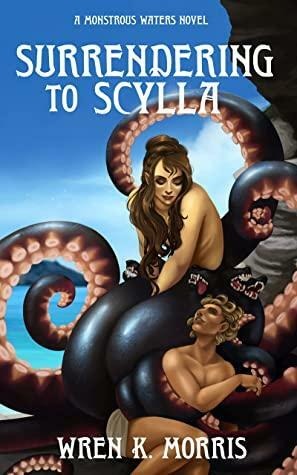
Surrendering to Scylla but Wren K. Morris

A cursed nymph living a life of violent retribution comes to love and be loved by a gentle, shipwrecked fisherman. She’s been hurt badly before, but through the power of his endless patience, a strong fawn response from his own prior trauma and the power of forced proximity, love is found (as well as general deference to her authority). 

It’s a Greek myth retelling and monster romance, between Scylla, the sea monster, and a man who is like not like the other terrible men she has met before. He is patient enough with her prickly side to let her come to trust him, and he is devoid of the dominating masculinity of all her prior suitors. There’s lots of overtly coded, unapologetic femdom and a lot of feelings.

If you like your ladies strong and your men soft, and you want to watch the most bitter woman in the world be loved anyway, you may find this was just what you were looking for. There’s lots of action, tentacles and high drama, and pretty reasonable pacing. It’s even the first book of the series, rather than sticking the femdom in the ass end of the book list when all the creative juice is wearing thin. Unfortunately I didn’t personally find it worked for me, but I can see why people do, and what in it was done very well. 

For positives, you get a heroine who is allowed to be physically monstrous, biblically accurate style. Scylla has tentacles aplenty and vicious dog heads at her waist, and rips several people in half. She is a Gothic villain in the style usually only permitted to male characters, the brooding brute. The plot is also constructed into a coherent narrative by someone who clearly knows their myths. A barren island’s cave system makes for a novel and occasionally oddly comfy setting. I liked the slice of life parts. 

Unfortunately, for me, all this is held back by a chronically weak male lead (in more than the physical sense) and a cartoonish level of simplicity to its approach to the bad guys. And, as a modern retelling, for all it tries to tweak itself to a more feminist framing, with its emphasis on female rage, the rewards of being true to yourself while opening up a little to love are a bit dubious.

I also found it couldn’t seem to commit to how unlikeable the heroine is supposed to be. That’s not something I would call a fatal flaw. It’s well understood that female characters are held to higher standards to sweetness and thematically this is about not having to be nice. Nonetheless, there’s a bit of awkwardness in how much we the reader are supposed to buy her self justification. Retellings of the villain figure stories often struggle with this, explaining away what modern audiences might particularly take issue with to the point of dilution or failing to address them satisfactorily. While the Greeks themselves gave most popular characters in their stories different interpretations that could be completely contradictory, I found Surrendering to Scylla a bit tonally indecisive in how bad it wanted her to be read as. Greeks often elided around that problem with tragedy, of which this would otherwise stand well as, but Romances have to give you a Happily Ever After. Unfortunately, this one tried to do so without deciding if the characters needed to resolve or soften most of their flaws, or lean into them. 

So, we linger on Scylla’s suffering to make her understandable, first her objectification as a nymph, her status as collateral damage to a deluded Circe, and so on. Usually this sort of framing is done to make a character’s behavior understandable and sympathetic. Inversely, she has an awful lot of self pity for a serial killer and very little self reflection about her own prejudices around other monsters. The story also acknowledges that she is actively luring people to their death for the crime of being in the same zipcode and not as discriminating a killer as she puts herself to be. Morris isn’t going for the me-or-them completely misunderstood monster. I actually liked this part, but her unchanging embrace of that came at the expense of Ophelo’s likeability in a way that I don’t think was intended. It also ends up highlighting how simplified all the other characters are in their uncritically described awfulness, which can be confusing.  

Because additional characters are left in very reductive shapes, it’s very undecided about what I would describe as how much we should take seriously the leads’  trauma goggles. Narrative seesaws between hints of complexity and hard binaries, where people are all good or all bad.  It therefore feels a bit like we are getting things through the perspective of our two leads, but not given space to acknowledge they are unreliable narrators. 

For example, in the setting “Sailors” are officially distinct from the male lead, a “Fisherman”. The former is a sort of long voyaging traveller, the latter, we are led to understand, is a skilled trade everyone spits on. Why do Sailors sail? Scylla would say they are greedy, but stops short of saying they are all raiders. They have treasures on their boats sometimes. That’s about the level of motivation we get here, so we can only infer most of them are traders. Regardless, Sailors are all characterized as absurdly awful, murderous jerks. Some of this is being played for laughs, with how ridiculous the characters are. But at the same time we are supposed to see them as a real danger to Ophelos, including implications (off page) he has been repeatedly sexually assaulted. Thus, the book struggles with the nuance it wants to insert. 

Scylla has a massive blind spot where her interactions with the world essentially amount to avoiding Gods and being exasperated strange horrid Greek men want to fuck her. She’s clearly never thought about any mortal who wasn’t cut in the heroic measure, and while those that do have nothing to recommend them, those that don’t are largely outside of her interests.

For example, she is hard done by and alone thanks to the curse. But she also keeps mentioning off hand there’s another monster in line of sight from her own home that she has clearly made zero effort to contact. We never learn why, but she is also offended to be compared to other monsters without a lot of caveats on Ophelos’s part. This isn’t one of those “monster is our word, you can’t use it” either. She just blithely assumes that her neighbour isn’t worth talking to.

Ophelos, on the other hand, is comically bullied. He is so bullied, the story makes it clear that even his father was bullied. Everyone bullies him so hard and so mean, but he kills and catches fish so good that the Sailors brought him along in the boat. The rest of his character is basically one giant trauma fawn response. When he isn’t fawning he is clinging. The clinging is framed as the courage of his love, but given the other thing we know is the only people who didn’t bully him were older women he helped in the past, there’s a streak of self preservation here that never gets addressed. And nonetheless, his actual backstory is life in a small village followed by travel with horrid louts. For all his time on boats he has never seen the world without bringing a gang of assholes with him wherever he goes.

While Sylla is permitted to do things female characters usually don’t get to, Ophelos’s most positive trait is his complete inability to pose any meaningful threat to Scylla. This makes her feel safe, but ultimately that’s all he can offer. It feels like in an effort to emphasize the distinction between them it ends up giving Scylla depressingly low standards. 

Ophelos embodies that observation that if you are the sort of person who waxes at length that dogs are better that people, what you mean is you prefer beings you have all the power over who depend on you completely. It’s not wrong to fantasize about making someone into your literal emotional support pet.  It just made it hard for me to feel Scylla was actually getting a good deal. 

I think my “come the fuck on” moment with this book was probably the relationship’s third real conflict. After an interlude of innocent-in-a-Gothic-castle style standard warming to each other, a gang of Sailors show up and attempt to fight Scylla. Ophelos wanders into this, and, after the Sailors’ offer of rescue is rejected by him, turns on Ophelos as well. As is a traditional trope, Scylla takes a mild injury defending him, but when she is snuggling him in the aftermath he is also not comfortable with the carnage he just witnessed and blurts out he forgot she was a monster.  Scylla reacts by storming off, rejection sensitivity dysphoria personified. When they both cool off, Scylla apologizes for not realizing gore could be off-putting… and Ophelos apologizes for letting his empathy get in the way of her murder and making her feel bad that he was openly upset. Even though, he says, he can’t help noting those dudes she ripped asunder could have easily been him, he knows she needs to do this as a part of herself. 

Not “you were only protecting yourself and me!” Not “you couldn’t help it, you lost control” or even “yes, it’s bad but your monster part needs to feed”. Just that this is important to her, so who is he to get in her way or question that? We see that Ophelos fully acknowledges that Scylla is a monster in the behavior sense not the physical sense. It’s this point that we realize just how cooked this young man’s brain is. Supposedly soft, gentle and almost cloyingly sweet Ophelos is very bought into his role as a barnacle on bad people. 

Scylla can kill a thousand other Ophelos, in his mind, as long as he gets to stay by her side. He doesn’t even characterize the victims as bad people, they just aren’t him so it is not his business. His thought process is that he believes he has to be with a monster anyway and at least this one loves him and confines the violence to others. Ditto, we are supposed to take Ophelos’s repeatedly refusing to be sent away as a strength of his devotion and character.  He is just more scared of being alone and losing Scylla’s angry defensive energy. Ophelos isn’t nice, he is a Nice Guy. 

I think why this galled me is that I spend a lot of time around people with a lot of overt female rage, and have had a fair bit of it myself. I am often spikey and bristle easily. And one thing you have to be mindful of is that there’s a category of Not Like Other Boys that will sort of remora onto women they see as having more fight than them. And notably they tend to conflate ability to be mildly helpful to people and a lack of their own ability to express agency as being inherently more good and thus above reproach (and more worthy of you). Ophelos gave up trying to be meaningfully good a long time ago, and his frightened reaction is supposed to be a momentary lapse he will try hard to get over.

There’s a bit in the last third of the book where she’s temporarily restored to a nymph and they maintain their D/s dynamic. Normally I would find that refreshing, as often resolving the plot’s source of conflict in a femdom story ends the dynamic. Unfortunately Ophelos’s unaddressed trauma and perpetual identity of victimhood dilute its impact. Scylla the nymph is still stronger than Ophelos, because his level of ability to stand up to her begins and ends with requesting that she only call him Pet during play (and not leave him alone). You get the clear impression that even subtracted from her physical augmentation, if she wanted to she could still take him to the tideline and hold him under water until the bubbles stopped. The part of her that made her a monster is also still there, even if the tentacles are temporarily back to legs. And, ultimately, they are basically living in a rental owned by her divine dad at this point. He might have insisted this is where he wanted to be but the alternatives have been clearly spelled out as death or more Sailor based abuse.

I also think the other point of hesitation for me is that in femdom circles there’s a tendency to be uncritical about the motivation for doing sadomasochistic hijinks is only just retribution for the pain of living under patriarchy. As a fantasy flavour it is no worse than say, pretending to be a pirate. As a thing to wade through though from people being serious, it’s basically the constant message that femdom is just another trauma induced personality disorder. Not that the drama of trauma can lead to accidental fetish material, but there’s a slice of the larger community who are doing this because they sincerely see it as a compromise needed to deal with the hazards of heterosexuality.

If Scylla, given choice, is still the monster, I would have also liked to have seen how Ophelos handled choice more meaningful than “noooo, I want to be with yooooooou” when confronted by separation others chose for him. Morris was probably being true to the myth here, in so much that there wasn’t any material to build out from, but at least once it would be nice to see him choose her when the alternatives weren’t objectively and unambiguously more crap. 

Nevertheless, being fair, this is a fantasy not a relationship guide. If Ophelos is little more than the rescue dog that encourages a traumatized woman to finally leave the house, that’s still an interesting story. And sometimes the best a real happy ending can offer us is living in a different, better house, and still with the good dog. Sometimes we don’t get over our bullshit or address our internal contradictions. And, I mean, come on, there’s graphic alien physiology monster sex. And captivity based femdom that stays femdom post captivity. And a happy ending that pleases the characters, even if it might not be perfect. 

“At His Countess’ Pleasure” by Olivia Waite [Femdom Book Review]

At His Countess' Pleasure by Olivia Waite. The cover depicts a woman in a red dress with clasped hands. She is standing against a blue background.

After a scandal between the families puts Anne Pym and her sisters in a socially precarious position, Simon Rushford, Earl of Underwood aims to resolve this reputational damage by making her his Countess. A whole bunch of light, entirely consensual femdom ensues while Anne adjusts to this marriage and comes into her own, with the rest of the plot conflict being driven by Anne attempting to live up to her own expectations as much as those of others, and Simon being a bit dumb. 

This is one of those 3.5 star situations, where its good parts were somewhat smothered by its problems. That’s not to say I hated the book, even if I was exasperated with it (and the characters) at times. Its main flaw is that it’s under done, but in the sense that it desperately needed more book to fill out what it was trying to do. Waite can write, with a particular knack for sex scenes, but the flow of individual pieces is very choppy. However, as far as erotica and hand under the covers reading, it executes what it is trying to do sincerely and with enough story and commitment to physical realism to underline it’s trying to take its own material seriously.

Other than that, though, the conflict here is probably the book’s weakest part. There’s plenty of problems for the heroine to solve, such as finding her feet in society, managing various scandals, and reconciling herself to things she can’t have, but we take until the last third of the book before there’s any real challenge. Capital R Romance (as a genre) has a beat structure and theme that isn’t being hewed to very hard here. Particularly germaine to abandoning forumula, the hero is a kind of gormless easy going individual who seems to exist to be agreeable and reassuring, but also cause most of the fuck ups. He is certainly very earnest, but also very stupid in a way that’s never particularly explored, essentially leaving the other half of the potential plot conflict entirely unaddressed. 

Particularly notable is that he is an utter dumb-dumb about sex, to the extent that a first major point of drama in the relationship is that he is flabbergasted to discover that a change in costume is enough to render his wife attractive. Nevertheless, his Madonna/Whore complex causes no further dysfunction in their love life and does nothing to change his opinion of her when he discovers she likes fucking him. This is a bit of a head scratcher that he is very bought into the idea of duty, proprietary and the fragility of women of his social class, but has none of the drawbacks this is usually packaged with in real life. 

Instead, Simon is written like someone who would be startled to discover carriages that aren’t painted red can still go fast. Inversely, Anne’s makeover from debutante pastels to bright colours (this being all it takes for Simon to realize she is hot) is in no way an effort to dress for his benefit, a purely happy accident. She likes fucking her husband, once he shows an interest in her, but her love for him never shifts from an increasingly appreciative check list. Additional tinkering could have taken this from Anne reacting to things and concluding it could be much worse, to her own example being a more traditional catalyst of change in her partner as well. 

Still, the main conceit the book is built on is pretty refreshing. Anne is a plausible sexually dominant, including approaching the inevitable historical romance virginity loss scene with full enthusiasm instead of a rather cliche reticence. Inversely, I enjoyed her hesitancy in figuring out her new social milieu and reconciling the real fact that dominants are not magic fountains of universal confidence. The plot, had it held together a little better, had its interesting points and avoided a lot of the more irksome versions of the tropes it explored. 

But I would have liked to see Simon ever have to confront the fact that he caused not only most of the problems in this book, but is largely insulated by his privilege in a way others are not. We are supposed to treat his marriage to Anne as some sort of mutual sacrifice, but in reality, he gives her a very difficult job entirely for his benefit. At no point does his terrible decision making process ever cause him real consequences, largely because Anne keeps dealing with it for him. No lessons are learned, Simon shall be Simon until he dies. 

This earnest range of fuck ups even starts with the prior book in this series, where we are told he plays an accidental part in the leaking of someone’s nude painting. The scandal from that is what puts Anne in a position where marriage to her is a sort of rescue, but even so she also represents a convenient solution to his feeling of obligation to marry someone out of duty. Then, once their sex life is off and humming we discover actually he knocked up his last mistress, but once again Anne is dealing with the worst of it entirely to his advantage. I am not even asking for a comeuppance. It’s just that Simon is never significantly impacted by any of this, and always less than Anne.

Indeed Simon does not get so much as a side eye from being surprised all the unprotected sex he had with other women he wasn’t married to resulted in pregnancy and then this secret being mismanaged by him. He talks about not being as slutty as his brother, and this, by his measure, seems to have been enough in his mind and nobody confronts him about this because the book keeps very modern sensibilities. No sex, no matter how irresponsible, is to be shamed. So, instead, he is briefly flustered by the mess, then Anne solves his problem, he then wanders off to play with the new baby. 

The strongest conflict, found in the last third of the book, doesn’t really concern Simon at all, just Anne putting up with a lot for her cousin (heroine from the last book) and confronting finding out something about herself that will impact their life together, rattling her confidence in the process.  This, about three months into their marriage (timelines are a bit rushed, it might have been max a year), puts a bit of a damper on their sex life while she deals with her feelings about that. It’s here you see where this would be a better book if Waite had given it more time. We could have built into this better about what sudden sexual dysfunction means to Anne. Instead, problem established we lurch into a happy ending by way of a pegging scene and then a time skip. 

Honestly, the pegging prose itself was well done, and so rare to find that I can forgive a lot. Nevertheless, it’s that ongoing choppiness of flow here that makes this scene nice but bewildering, rather than fantastic. What could have been an additional escalation becomes simply a dildo out of left field. 

To emphasize on how bizarre this is, nothing to this point suggests anything more sexually adventurous on Simon’s part than oral sex. A bit of editing could have handled this better, dropping the more complicated kink sooner into his perspective or maybe exploring that as part of the Madonna/Whore thing we started with. Instead we are left head scratching. How does Simon know about butt stuff, a historically realtively supressed sex act even compared to oral? We never get much insight, but for plot convenience he has a porn image to share with his wife as a way of guide and the firm belief this is just what Anne needs. Is this a secret vulnerable fantasy he dwelled on, revealed only as an act of trust? Did he do this loads with those prior partners? No, it’s pretty much just Simon doing Simon things.

By his logic, if Anne is feeling depressed enough she doesn’t want to do PiV, clearly what Simon thinks will cheer her up is putting a dildo in his butt. Tahdah, no more pressure on her to be wet enough to penetrate! Luckily, as pretty much every other hare brained idea of Simon’s so far, it goes great. 

About the only thing I can say to Simon’s credit is that he always does the wrong thing, but says the right thing afterwards. He offers Anne no help figuring out posh society, but cheerfully reminds her she is doing great while watching her struggle from the sidelines. He drops a surprise baby in her lap, fluffs about in a panic until Anne rescues him and then turns into instant perfect modern dad so the audience can coo over baby time. When Anne is sad because of a thing she has learned that impacts their sex life he says something supportive about centering her feelings not his. And then he offers her his butthole in this trying time. 

This is probably something of a pattern with how the book treats solving problems. When Simon played a part in harming Anne and her family, his solution to marry her is treated rather like a unilaterally good thing, rather than either excessive to what had been actually asked of him (and a gift with considerable strings). When the impregnated former mistress shows up on the doorstep, Anne in turn adds her to the household with a job, purely so Simon can get more time with the baby, and we are supposed to assume that this is a lovely, gracious thing to do to the other woman and not, again, a hard job that asks her to continue to subordinate herself to both main characters for a problem largely caused by Simon. The pegging at the end is almost a rule of thirds conclusion of this pattern. The problem of being unable to feel as aroused because of a very real point of stress is treated like Anne’s problem that Simon tenderly solves. In reality, it’s Simon saying “here is a sex act we can do when you aren’t as horny that will still benefit me”.

Simon adds to Anne’s life by adding massive social prestige and wealth, but in his own self characterization, this is more like the desirable cart attached to a particularly clumsy ox. The rest of Anne’s life is not particularly a net positive by his presence in it, and at times he feels his positives are more like a sexy lamp that could be replaced by a wise mentor stock character. One can even read a darker interpretation of his marriage to Anne that he knows he’s actually offering a less than good deal and figured her desperation would make up for it. 

These, incidentally, are all interesting conflicts that could have been addressed if we had about 25% more book. I credit Waite here that she’s clearly got the insight and writing ability to have ironed out these problems and made Simon either less of a bliss-ninny or have him reign in more of his worst tendencies in regards to this flaw as part of character development. I also don’t think the circumstances this was published in gave Waite the support to do so, thus one can’t complain too much.

This forms, by the way, the crux of my review dilemma. To nurture more femdom books into existence, existing works must be more widely read and shared. Nevertheless, this must be done with compassion and the knowledge that writers in this niche are operating at a severe disadvantage, most typically in the indie space.

As an indie, “At His Countess’ Pleasure” must be judged, not by the standards of the bigger budget books, but what is accomplished with less. One thus forgives much: typos, lower grade graphics on the covers, things that didn’t always land as precisely as we might hope, and so on. Often they are the byproduct of a single creator wearing many hats, and these errors really can be treated as irrelevant to the overall whole.  As an example of the genre of Romance, and assuming the creator had all the tools of a big budget book, this needed to go back to the metaphorical kitchen. As an example of something put together cottage industry style with no support to speak of and profit margins that border on an entirely labour of love level, Waite pulled this off phenomenally, bringing her talent and technical skill to a part of the book market that can trend into shovel ware. 

Thus my conclusion: it wasn’t a waste of time to read this and if Waite does any other femdom I’d happily give that a shot too. As an Erotic Romance, it’s a bit weak in how it assembles the R part, but if you are into firm but gentle F/m, the E is solid and could stand on its own if that was all you wanted.


Where To Buy: At His Countess’ Pleasure by Olivia Waite

That Time I Hate Read a Femdom Romance

(And then sort of came to appreciate it)

A book cover, "Melt for You" by G.L. Tomas

This is not a positive review of “Melt for You”, but it’s also not an un-positive one.

Ask the lifestyle dommes of the internet and one of the most reliable things we complain about is that we do not feel represented. We don’t see ourselves in popular media, except accidentally or with a Hays Code style tendency to have our stories end in punishment. We know we aren’t the target of most porn, even when it’s ostensibly about us. We also sit through a lot of things that claim to be neutral, but re-enforce our opposite as the default, not just vanilla, but femsub. To be a lifestyle dominant is to be simultaneously called a unicorn with infinite suitors and called irrelevant, a rounding error in the planning of creative people in the world. 

Inversely we also have a pop culture that likes to fantasize that the dommes of the world are, if not the bad girls to be punished, the patron saints of not being impacted by all the other “-isms”. A whole cottage industry exists in teaching women to embrace their inner domme (or manufacture one) for a raise, the upper hand in their personal relationships, an end to imposter syndrome. This doesn’t work, but it doesn’t stop the first word people pair dominant with being “empowered”. Being one just doesn’t magically change the rest of the context you are trying to do it in, and most dominants feel very neglected by the collective Gaze.

We desperately, absolutely beg and plead for something more, and the market is actually starting to deliver. Unfortunately that poses another problem, that just because something exists doesn’t make it good. As part of my commitment to try to popularize and curate more domme fics, I have been reading a lot of dog awful stuff. Some good things, but there’s a few dozen books now, where I tried to get into it and had to give it the dreaded DNF.

Usually I let the crap go unremarked. I talked about this here, already, that reviews of our itty bitty niche therefore needs to be done with a bunch of forbearance. If something isn’t actively harmful (like The Control Book), if I don’t have anything nice to say it’s usually better to say nothing at all. With this book, when I initially read it, I ripped it to shreds in a series of angry blusky posts as I went, but I scrupulously didn’t share the title. I am breaking my usual rule, however, because I think even if I hated it, there’s still something of value it gave me, and it might give that to you, too. 

Melt Into You: A BWWM BDSM Romance, as well as following the trend of indy published romances starting to resemble the same title traditions of lightnovels, was an attempt. It was a swing, and a miss. It was not just bad, but layers of bad, but… it’s a good thing the author tried. And the focus is still interesting.

The TL;DR is that a newly minted surgical tech and domme blogger/podcaster/educator hooks up with a wealthy doctor, with neither of them then expecting to work at the same hospital. Both characters have disabilities, and the heroine is black and the hero white. It’s part of a larger series, by a 41+ books written and counting USA Today best selling author G.L. Tomas. 

Obviously we want more of all that: characters who are PoC; characters who are disabled; dommes who are acting outside of a sex work context (or if they are, stay sex workers after the HEA instead of being “rescued” by a relationship); lifestyle dommes being normal, flawed people; even subs being whole people, not automatic doormats. This review is not even a “this, but not like that!”. It’s partial credit with a bunch of caveats. 

Sure, I could enumerate its faults, big and small. Globally, it has the problem of attempting to be educational while  actually showcasing lots of sketchy behavior, and attempting to be woke while having some very questionable choices. It also is about 50% infodumps through the character explaining to you the reader. 

But, notably, it’s a fantasy about me. Not necessarily me specifically, as in Pearl the person, but a group of only a tiny handful of women, probably less than 200, maybe even 100 depending on how you define it. A very specific kind of domme. Not a professional domme, not a girl next door, or a woman with real meat space authority who happens to be kinky. An influencer. It’s a fantasy of being Ferns, or Venus Cuckoldress, or the other tiny slice of women who make their desire to dominate in a lifestyle relationship the anchor of a vocal and vaguely respected online presence. It’s imagining what our life is like through rose coloured glasses, but hey, I am seen… even if I am all pink and kind of distorted! 

What it also says is that the author, when it comes to describing femdom, turned to us as examples. They often had a touchingly naive idea of how the sausage is made (the heroine has a person who gets her sporadic paid kink related speaking gigs, there’s no Patreon mentioned, she made the hero a Tiktok star in a matter of months), but holy shit I am not going to get mad they think my life is better than it is. There’s value in me kicking over my own pedestal, but it’s not the author’s job. 

Reviewing it also forces you to confront how many issues in text are actually realistic even as they are regrettable and how much of the unreality is basically a symptom of the genre of romance, not the fault of just the author. If I lay any sin at the feet of the author, it’s that they don’t seem self aware of the book’s flaws and contradictions. But it’s a lot to ask of someone to be completely critical of their own work when they were, based on my knowledge of the publishing industry, getting paid peanuts and probably wrote this in a month. 

Is the hero kind of a turd? Sure, but alphahole is a common descriptor of characters in a romance genre for a reason. A good part of romance is a conquest fantasy, the woman winning out against the man over the arc of the story. It’s supposed to be about her wiles and magnetism versus his power, lifting the hero up as high as possible only to make his inevitable fall (in love) more spectacular. 

Is the heroine a nincompoop? Yes, but often we all are, and romance as a genre demands vulnerability to allow for the ever present rescue fantasies and a sense of growth. If she wasn’t bad with money enough to get stranded without enough twice, how could the audience justify him giving her guilt free sugaring? If she wasn’t spectacularly bad at vetting, how would we have the surprise second act where they end up at the same workplace?

Do the social justice parts undermine themselves through some very questionable behavior and as much through over-explaining like the characters were ambulatory tumblr bios given life and the audience are idiots? Sure, but would it be really better if the author didn’t try?

Are they absolutely fucking bizarre about the hero’s Greek heritage, including characters declaring him being a completely different group they find sexier? Yeah, but as someone also on the ethnically ambiguous side of white (enough to trigger “where are you from” conversations and random racists to occasionally fling slurs), boy am I used to people speculating what I am and thinking it’s a compliment to assign me a completely different background! 

Interestingly, buried in the book is also a plausible, but much less happy story. It’s one where kink educators often barely know what they are doing and do creepy shit like asking out a demo bottom in the middle of the class. It’s one where trust in the idea of a safety mechanism replaces real checking; getting an STI test so you don’t read it (or know how to follow up with a past partner later), making a safe call without sharing someone’s name. It’s a world where you repeatedly get put into sketchy situations by your mentors. 

It’s one where someone is kind of racist and only considers your perspective in an issue because you are fucking (while still sounding incredibly insincere to others); and where a relatively impoverished person gets sporadically bombarded with money that always has implicit strings. One where marrying well, to an older man often will beat anything you can achieve through working your whole life. One where that dude is the sort of person who will enmesh women into their life and then leverage the power they have over them in a way that fails to consider the power relationship they have while also downplaying real harm and danger. 

That story is painful, and littered with fuckups and awkwardness that made me hoot incredulously, but I still read the whole thing when I could have just dismissed it to the DNF pile and never mentioned it again. It was bad, but entertainingly bad. That’s not nothing. I hated it enough I was completely entertained. Based on how much I enjoyed being annoyed at it, it would qualify as fun as any of the stuff I would give 4 stars to.

Taken as an attempt to pair BDSM education with a romance, this failed to demonstrate safe behavior, drastically undermining its goals. Taken as a symptom of the author’s heart being in the right place, while writing an otherwise bog standard Greek billionaire doctor romance I could buy at the grocery store? This is absolutely not something I would waste my breath being angry about.

And ultimately, 10 years ago, a book like this wouldn’t exist at all. It means that what I did as a small part of a larger project to make being a lifestyle only domme more visible, worked. I can’t help coming away from reading this less irked and more shaking my head indulgently. 

Femdom Review “Wooing the Witch Queen” By Stephanie Burgis

The cover of "Wooing the Witch Queen" by Stephanie Burgis. It shows a shorter brown haired woman in a blue dress and crown clutching the chin of a taller man with curly brown hair. They are in a library with a raven and a silver mask nearby.

This is PG-13 rated femdom. No, I am not kidding, someone has managed to get a three book deal from a mainstream publisher for a no sex young adult aimed romantasy series about a trio of evil witches and the subs that love them. 

Lest you think I am just inferring from the setting, no, I do mean this is an intentionally kinky book. In the scenes in which the two leads (Saskia, research witch) and Fabian (aka Felix, nobleman in disguise) discuss their feelings, with each other or in their heads it is expressed in terms of his submission. The scenes of fooling around are written entirely as consensual physical domination. But, there’s no sex in page or even a fade to black and the text gives you one stark “fuck” as far as cuss words. This is explicitly appropriate for who this book is aimed for, a person aged 12-18.

The reading level, likewise, took me about three hours (including a break) to zip through it. Tonally, it lands 100% in the current trends for Cozy and Villain-Is-Actually-Hero. This is about youthful wish fulfillment and vicarious ambition, defying your wicked guardians and coming into your own power. Also getting to be goth and spooky while you do it.

And it’s neat, because it both underlines the femdom-hiding-in-plain-sight thing I keep going on about and suggests a market of increasing tolerance. With a small mountain of books (YA or otherwise) where the heroine has to struggle to understand the moody supernatural male and navigate his power they implied threat of that, it’s good that I can go into a Barnes and Noble spot a book where the heroine is maybe a little menacingly clutching the hero’s face with her hand and have it actually deliver. 

Nonetheless, I think it’s worth going into this review to also point out that if there wasn’t a clear flag of potential Femdom on the cover I wouldn’t have bought the book. While it was true I read a lot of this kind of fantasy when I was the primary age this is aimed at (in my day it was Dealing with Dragons, Myth Adventures, etc…), but I am pretty old. My wish fulfillment wants are now those of middle aged marrieds. I don’t want to defy my parents anymore, I have to think about them dying and what it says for my own mortality. I don’t need to realize the power was in me all along, I have to think about how to navigate passing the things I built on and symbolic or literal parenting. Young me would have gobbled “Wooing The Witch Queen” up and added it to her head library. Older me has to go into what is ultimately a positive review with the awareness my biggest criticisms are all aspects of it that are Not Written For Me.

So, before I do my usual grumpy fussing, let’s first talk about the unequivocally good parts. Fabien/Felix, our male lead, gets to be hot and useful. He doesn’t need to be cast as some sort of weirdo that he finds our heroine Saskia fascinating. Indeed I suppose there’s one wish this book did fulfill, it’s living in a world where women can be dominant and not have the entire narrative structure say “WHAT A SHOCKING REVERSAL OF ROLES!!!”. It’s like when you are queer you get very tired of coming out stories, even if that’s part of the larger queer experience. This also isn’t a gender flip story where he has to be more feminine to permit her to dominate, it’s just one where being attracted to villain coded people or wanting someone to kneel for you is equal opportunity.

While I told you there was no on page sex, there is, what I would describe as a very well done emphasis on flirting and starting to initiate as a domme, written with a good balance of situational chemistry and emphasis on consent. A main conflict is that after the leads determine they are into each other, Fabian/Felix still needs to reveal he’s actually in disguise and not the person she assumes him to be. But there’s a lot of on page yearning, pressing up against each other and touching with the offer of domination if the other party wants to lean into that while still leaving them room to back out.

Seriously, this is what I mean when I say that BDSM is often unfairly over sexualized in a way it doesn’t need to be. Nothing lewd happens here, in the entire book. At closest, the word “aroused” is used once, but we get no specifics. It might as well be a synonym for attracted. And, in the inevitable HEA, the characters are cuddled in bed together, but the description is so scrupulously free of even the suggestion they are naked that you might as well assume the male lead was reading some more of his poetry to the heroine. That’s actually kind of refreshing. D/s is permitted to be just what some people want by default.

However, now I do need to put my caveats. The biggest one is an accidental side effect of the fact our hero spends most of his time completely swathed in fabric. When our hero flees to the titular Witch Queen’s domain seeking sanctuary, thanks to a fortuitous choice in cloak he is mistaken for a Dark Wizard and promptly hired to staff. Our heroine, for plot convenient reasons, refuses to look under his hood. Shortly after this introduction, his disguise is added to with a mask the last Dark Wizard left behind. That’s just a vocation in this world, mysterious shrouded magical figure of menace. The problem here is that the text also keeps having everyone reacting to him like he is stunningly hot. Of course when you have a character essentially wearing a niqab for three quarters of the book that doesn’t preclude communicating chemistry in other ways. You could emphasize his posture, the bits that show like his eyes, talk about scent, or pad things with sparkling dialogue. Hell, you could just describe the cape itself as intriguing.

Wooing the Witch Queen doesn’t. It’s the world’s slowest strip tease, from masked to half mask, from cape to a formal suit and bare face. But, even when the characters have a moment of being pressed together, the narrative stays perfectly coy about specifics. It tells you this is a very alluring scenario, but it doesn’t show why. One can do asexual alternatives to stereotypical attraction without completely jettisoning sensory specifics. 

Additionally, there were places where the elements I will call Cozy wore a bit thin. For example, our Witch Queen, Saskia, lives in a castle full of monstrous staff. They are of course, Just Misunderstood by bigoted humans, but in addition to that, they are slavishly dedicated to serving the leads. This is unlike the other two secondary plots: Saskia navigating that her First Minister is her ex girlfriend, and her reluctant friendship with the extremely extra other two Villain Queens she is in alliance with. Both are storylines where the motivations of the characters are more complicated. The Troll housekeeper and major domo, not so much, for all they constantly demand appeasement. While I get that having surrogate parents who are endlessly giving of every domestic comfort is a fair fantasy to have, it would have been nice to let the Trolls or the Goblins have wants and needs more personlike. One more plot about the monsters wanting something more than you to eat their perfectly made scones and to get enough sleep (or maybe making the Trolls/Goblins more morally grey) would have fixed this.  

And yet, for all of that, this book didn’t collapse too far into the problems that many Cozy books do, of destroying their own stakes to save their sweetness. The tension with Mirjana, the First Minister, made sense given that she both led the rebellion that put Saskia on the throne and is doing the actual day to day business of running the country. I also admit I made the mistake of thinking she was actually a sentient magic mirror until she showed up in person (I mean, her name is right there! Also she’s obsessed with Sakia’s public image!), but I found the conflict was a plausible problem and the resolution worked, even if I am sort of sympathizing with Mirjana here more than maybe the narrative wanted me to. I also likewise didn’t find the way the threat of invasion ended too was convenient. Cozy books are going to magically have a reason why you need to take the army on your border (or the villain threatening your goals) seriously, yet also not have a single person die. Without going too far into spoilers, the book did a good technical job of building to a zero bloodshed resolution that didn’t feel like it was just handed to the heroes.

And I think the best endorsement I can give is that I do plan to buy the next book in the series when it comes out. I expect pretty much more of the same, (cozy, but no sex) since Queen Lorelai of the Fairies spent a good part of her dialogue making sure we knew how much she loathed her future love interest and vamping about being a man eater without talking about precisely what she was doing, but I am absolutely here to see how Burgis pulls it off.

Author site in lieu of Amazon link:

“The Damsel” by Victoria Vale [Femdom Review]

TL;DR: A rattling good thriller/historical romance with a violent and aggressive heroine finding peace in the unconditional love and submission of a genuinely supportive male lead.

If you are looking for femdom romance novels, one of the places they hide is the back/middle of a series that is otherwise dedicated to different kinds of BDSM pairings, usually M/f. Most frustratingly, most tagging systems do not make the distinction of who is doing what to whom, with no distinction in most blurbs or tagging. Finding femdom is about looking at a lot of stuff marketed with a “take charge heroine” and trying to determine if they mean a strong female lead with a lot of agency outside of the bedroom, but a sub in bed (or vanilla), and a domme. Even the cover, with this one a particularly well done example, can still turn out to have been a gamble. Nonetheless, sometimes you get a hit.

The Damsel is very much in the pattern of this sort of hidden gem. Looking at the cover and context, without word of mouth, it would be very hard to realize that this is pretty much what the audience asking for more femgaze femdom content is talking about. You get a sexually sadistic (without being hateful) and competent heroine, a sexy male masochist who is a value add to her life, and a plot that allows her to be vulnerable without completely defanging her. There’s adventure, peril and high drama/high chemistry sex. If I had to describe the dynamic I’d say tsundere domme with a sub who is more german shepherd than golden retriever. He’s here to devote himself to her, but the story emphasizes just as much his intelligence and ability to show teeth when she needs it. 

When we meet our heroine, Cassandra, she is reclaiming her life after surviving the double trauma of a sexual assault and then the public testimony necessary to secure a conviction of her attacker. At the encouragement of a friend she decides to find a one night stand, propositioning the first man who seems attractive in the common room of an inn. That turns out to be Robert Stanley, an unusually handsome young man from her aristocratic social circle, who just happens to be there nursing being dumped by the heroine of the two prior books in the series. Luckily you don’t need to read those books to follow along here. This is a completely stand alone story with all the focus on our current characters.

And wow, what a ride! Cassandra struggles with her status as a ruined woman, a pair of horrid sisters and a mother who is more concerned that she will taint their reputation of the rest of the family than the wellbeing of her daughter. The world of good society lets her linger in a sort of twilight space, whispered about but still allowed on its fringes. Cassandra, for her part sees her victimization not as a one off experience, but an enlightenment into the violence all women have in common and has set out to do something about it. Much of the plot follows this dark mission, but even for a high drama thriller it has a lot of well depicted accuracy around the damage of sexual assault is not just in the moment, but in dealing with how people treat you afterwards. 

That being said, if you need your BDSM super negotiated and clear up front, this book might give you pause. Cassandra leaps into aggressively topping Robert without any conversation about limits, getting him to agree to be tied to the bed before going to town on him. I can give this a pass, under the grounds this is a fantasy and isn’t pretending to model healthy relationships, but this can be a hot button limit for some kink readers. Likewise the thriller side of the plot eventually put the heroine in some pretty graphic danger including the risk of more sexual assault, so if that’s triggering or your comfort place is never seeing the domme character even temporarily helpless, you may find this isn’t your cup of tea. What I can reassure readers, however, is that our heroine acquits herself magnificently even at her darkest and most defenseless moments and the dynamic that slowly develops between her and Robert is one where she trusts him enough to make things more of a collaboration in all things.

Also, blessedly, What this book doesn’t do is conclude she’s only a dominant because she survived rape. Though the context for her initial exploration is reclaiming her agency, and the trappings of BDSM are initially justified by her as simply protecting herself from potential violence and keeping the hero at arms length, one of the main conflicts of the book is Robert helping her see that she isn’t broken, she just incidentally happens to be kinky. Inversely he is never at all self conscious about his own enjoyment of being mauled, and any trauma of his own is not related to his desire for submission. It also is very good at having the hero able to disagree with some of her methods without implying she’s wrong in how she reached her conclusion. I won’t spoil some of the twists, but the title hints at the core theme of the book, that you can still be seen as a stupendously component badass and deserve all the rescue and protection of the titular “Damsel” archetype. 

Trying the Solace by Lovense

Testing the Solace Does it live up to the fantasy an image of the Solace remote control masturbation sleeve by Lovense

Is the Solace good, though?

Short answer: 

The Solace is ambitious, creating a toy in an underserved niche and miniaturizing a fucking machine to a bit bigger than a chunky loaf of bread.  Unfortunately, the tech is not there yet, but it’s a good try and incredibly impressive for what it is. If you are an early adopter, or get off on the aesthetics of machines themselves this could be a great fit. However, there’s a few design flaws here that make it not quite the winner of their other products.

The toy might be priced at $369, but never in my history of buying from them have they not had pretty steep discounts running at all times, including of all things a %60 off for students. In reality it will probably set you back something in the range of $184.

Long Answer:

Lovense is one of those popular brands that has a pretty established presence as the defining version of a niche category: remote controlled sex toys. I have a long history of ending up in LDRs where anything horny is happening at a distance. Silver and I filled that gap by buying various and sundry Lovense products, and he was a fan even predating our relationship. I am usually the worst reviewer in the world for stuff (I don’t like most things and I can’t do the reviewer vague positive that would ever make it a reliable business model for me), but I have had enough success with Lovense in the past to take a gamble here. When Lovense reached out to maybe, possibly consider an affiliate code sign up, I decided why the heck not. They were even willing to send me a toy to review, and me, being shameless, asked for one of their fancier options, the Solace.

That being said… the Hush is their old reliable that I would recommend to anyone with a butthole, but Silver, on his own, tried their prostate version, and I got him the Max one year (the OG edition). Neither of those worked out quite as well. They make good anniversary/birthday/christmas gifts, and I have remarked before that I was pleasantly surprised by the Gravity (my review here). Alas, lightning didn’t strike twice.

I really wanted the toy, a penis engulfing, handheld milker, to work for us. It’s a concept that fits really well into my fantasies, a relentless, hands free apparatus you strap someone into and they are mercilessly teased and drained. If it had worked as well as I imagined, this would probably be a Lovense stan account now and Silver would be lying comically shrivelled in a puddle of lube and semen.

But, in the history of sex toys, onnaholes simply have never gotten the love of dildos, plugs and vibes. When it comes to things you stick your dick into, their relative lack of penetration (snrk) to the western market belays a bunch of psycho-social biases that give the technical side of the problem less of a foundation. A buttplug is a solved problem Lovense is simply improving by adding their app, a powered masturbation sleeve is an experimental satellite launched to sample Mars for evidence of life. 

So, I certainly applaud the company’s ambition here. Lovense takes some pretty big swings, trying to adapt their system to everything from a vagina operated control stick for their other toys to nipple clamps, and that’s generally a thing I care about. Teledildonics is a tech that I will never say no to innovation in.  However, the problem with the Solace is threefold:

There’s not enough sensation, it’s hard to operate and it’s loud.

Loud is forgivable. It’s the Mach I of a motor driven toy. When we tested it, the noise part was dealt with by putting a hood on Silver so that it sounded a bit less like you were getting a panicked hand job from Beaker. Loud might even be a value add if you are one of the many folks turned on by knowing this is a machine, so if that was the only issue I would have been able to ignore it. If we are being fair, the Gravity is loud too.

The operation challenge, unfortunately, is the make or break part. Some things were seamless. It connects and controls with the app beautifully, and has buttons on the unit so you can do manual if you really want to. Points there for making a toy that doesn’t brick if they stop supporting it. For the person controlling it from a distance it’s easy as pie to figure out. One slider controls depth of thrust, the other speed. As well as full control, you can create a loop or leave it on one setting while you do other things to the victim. All very good.


The problem comes from the deployment part. It’s hard to keep your dick in it, and it doesn’t offer enough stimulation to get you anywhere on its own. Worse, if you wiggle too much the safety feature to prevent the motor from burning itself out doesn’t let you hilt. It will immediately stop moving with a worried whine. At no point on Silver was it going to the base of his cock. If he wiggled at all, which most aroused people will do, his cock easily popped out and sort of wobbled uselessly next to the unit while it still shrieked away, hell for leather.


The manual suggests two options, attaching it with the included brackets to the front of a desk, pointing down (as if you were doing a cam2cam session with someone else) or simply holding the whole unit in place on yourself, on all fours. I don’t know how Lovense thinks this is going to work, but the external housing is rounded hard plastic. Not only is it bigger than the average person’s hand span (and awkwardly heavy), but there is no texture on the exterior. Add some lube and you are immediately going to drop this puppy. If this ever gets a Mach II this needs a handle and some external grippy silicone. I can’t stress how much the base to brace off is essential in a thrusting toy, and if you want to hold it on yourself you will need both hands. 

Furthermore the dependence on the desk bracket is doing a lot of work in assuming the height of your desk and the clearance between your lap and chair. We were lucky, as I own a sit stand desk that can be adjusted exactly so. But if you don’t, you may struggle even more than we did. You will not be using this, despite the advertisement, “slumped on the sofa” or “lying in bed” without some extra work and I don’t know if this unit would handle being stuffed between mattress and box spring the way you can a Fleshlight.

The sensation problem is perhaps the last point of concern. I get that Lovense’s safety feature on the motor would be at odds with the toy having any availability to grip, but they are offering what is in effect a stroking toy, but one size fits most and without suction, that will be largely stroking the middle third of a penis. If it can’t suck, it needs to vibe or it needs a heck of a lot more texture. Otherwise on most people it’s a whole lot of effort for nothing in particular as far as outcome. And that, given what the toy is trying to do is a unfortunate. They do offer a tighter “vagina sleeve” as an aftermarket add on, but unless the depth issue also is fixed I worry that isn’t enough and the innards of that sleeve might still not bridge the gap. It’s also pretty baffling that if you hop up in price point to the Solace Pro their default sleeve has a lot more texture. Was there really that much to be saved when they both have a base price of $369 USD?


At this point you are probably wondering why you would even bother with this and I am probably going on some reviewer blacklist somewhere, but I will reiterate the positives…

The good stuff about the Solace (and the brand)


At least based on porn and fantasy, people really, really want this toy to be a thing and bless them, Lovense is taking the problem seriously. Particularly in the niche of femdom, stuff that flips the gaze to focus on the bottom is a breath of fresh air. This toy is clearly designed with the vagnina based control stick I mentioned as the intended pairing (the Mission 2) and that’s spaceage level miracles.

And if you do want a hands free remote control option that you won’t struggle to hold, there’s always the Max 2, which is outside grip texture all the way, or the Calor, which leaves the squeeze in the hand of the one operating it. The tech here still has a lot of room to grow, but it’s clear that Lovense considers it a priority when they offer both their regular and pro edition.

I’m also happy to note you can get replacement sleeves for incredibly cheap ($15 USD if there’s no sales), and since this part will be the bit that needs changing most often (soft materials mean porous) this significantly increases the possible life of the toy. Furthermore, I haven’t experimented with cramming other maker’s sleeves into the channel, but the design is so simple it does suggest some aftermarket modding is possible. If you are into cutting edge sex tech, wanting to mod your stuff is probably your default state.

Lovense, as a company, is also surprisingly affordable for what you get. I already mentioned they are always running sales, but for bang for your buck, you will generally get what you paid for. And, while this one might have undershot the target a bit, but given a year or two I suspect their 2 version will have made up considerable distance.